I Wrote for Social Media for 30 Days. Here's What Doubled My Audience.
Are you pouring 10+ hours into a single, deeply researched article, only to hit "publish" and hear… crickets? Does the thought of manually copy-pasting and reformatting that same piece for LinkedIn, Substack Notes, and other platforms feel exhausting, especially when it gets just three likes before vanishing into the algorithmic void? If you’re stuck on a content treadmill, creating valuable work that nobody sees, I know exactly how that feels. For months, I was trapped in that same cycle of high effort and zero impact, watching my best ideas die a lonely death on a single platform.
The Agonizing Cycle Of Great Content Nobody Sees
I’ve been there. I used to pour 10 to 12 hours into a single, deeply researched Substack article. I’d hit publish, feel that brief rush of accomplishment, and then… nothing. Just crickets.
That silence was always followed by another few hours of clunky, manual work. I’d clumsily try to reformat my masterpiece for LinkedIn or a Twitter thread, only to watch it get three likes before vanishing into the algorithmic void. My social media writing felt completely disconnected from my main work. I knew the ideas were good, but my process was a total mess.
I was stuck on a content treadmill, creating valuable articles that lived and died in one place.
The Disconnect Between Effort and Impact
My old routine was a textbook case of wasted potential. I'd spend a full day on research and writing, then burn another 2-3 hours manually copy-pasting and tweaking that content for other platforms. The return on all that extra effort? Pretty much zero.
My LinkedIn posts felt like awkward afterthoughts, and my Substack Notes were just bland links pointing back to the original article. This wasn't a growth strategy. It was just "being on social media" without a purpose. A screenshot from my analytics back then would have shown a flat line for referral traffic—proof that my efforts were failing.
To break this painful cycle, learning how to write viral hooks that stop the scroll is a game-changer. The problem was never the quality of my ideas; it was my failure to package them in a way that worked for different audiences.
The big realization was this: Your best ideas deserve more than one shot at being seen. If your content only exists in one format on one platform, you're leaving 90% of your potential audience on the table.
Why Platform-Specific Writing Matters
Every social network is its own little world, with unique user habits and algorithms that reward different things. The numbers tell the story. While global social ad spend is projected to soar to $406.45 billion by 2029, the real opportunity for writers like us is in organic reach.
Consider this: in 2025, TikTok led the pack with a mind-boggling 3.70% engagement rate, while LinkedIn crushed it for B2B with multi-image posts earning 6.6% engagement.
It’s simple: writing for social media isn't a one-size-fits-all game. What resonates on one platform will almost certainly fall flat on another. You can get a better handle on these metrics by understanding what impressions on social media really mean for your growth. The data is clear—tailoring your content is essential.
My 30-Day Game Plan: The Cross-Platform System
I was completely fed up with wasting good content. I’d spend hours on an article, hit publish, and then… nothing. It felt like I was shouting into an algorithmic void. That frustration is what sparked a 30-day experiment with one single goal: grow my audience without creating more work for myself.
The core idea was a smarter "write once, publish everywhere" system. Instead of just mindlessly copy-pasting links, I built a framework to break down one big "pillar" article into multiple, smaller pieces tailored for each social platform. My targets were LinkedIn and Substack Notes—two platforms I felt could feed off each other's growth. This was my blueprint to stop being just another content creator and finally become an effective content distributor.
The old way was a predictable road to nowhere. I was stuck in a frustrating loop of high effort and minimal return. This visual pretty much sums up the cycle I was determined to break.
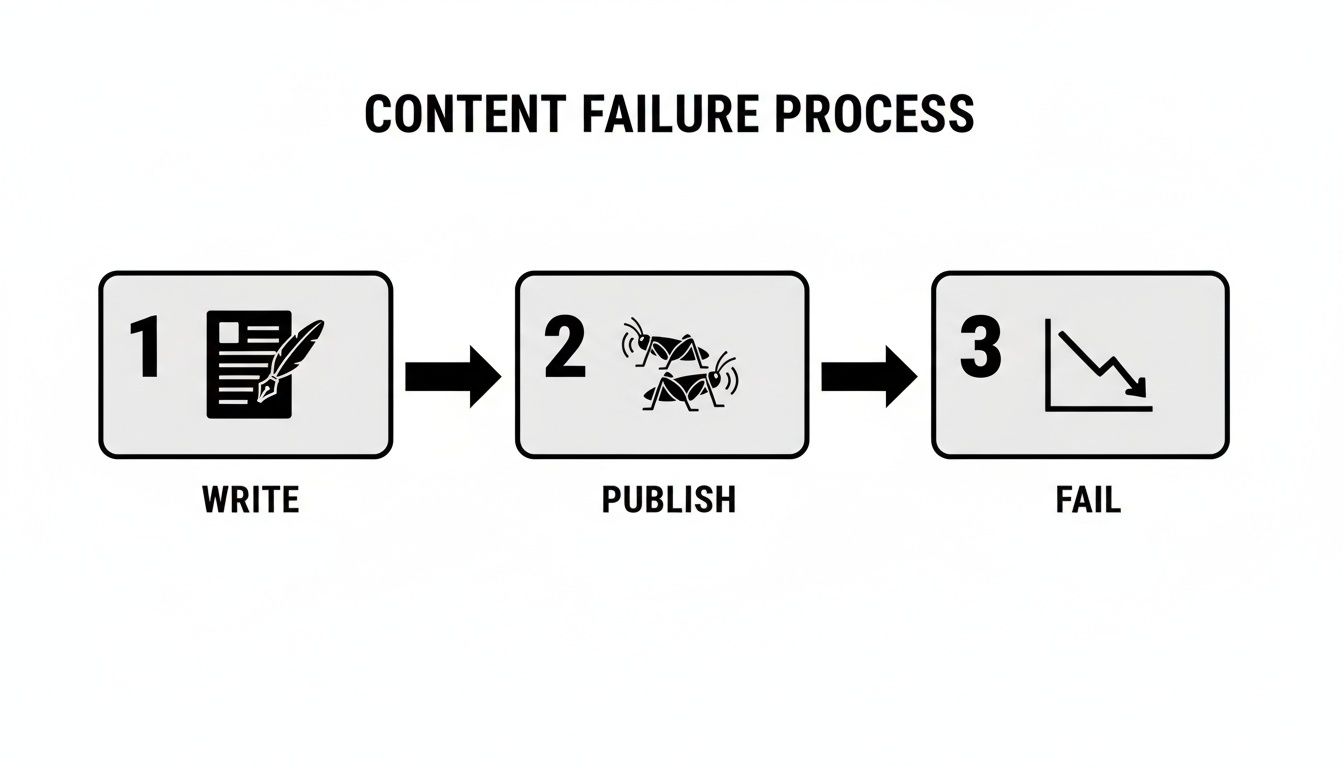
You write, you publish to silence, and the effort dies. My new system was designed to completely shatter that linear path.
Choosing The Pillar Article
The entire system starts with picking the right piece of "pillar content." This can't be just any article; it needs to be a foundational piece, packed with insights, data, and a strong point of view. For my experiment, I chose a 1,800-word article I’d written on the future of personal branding for writers.
It was the perfect candidate for a few key reasons:
- Multiple Angles: It had at least 5-7 distinct sub-topics baked into it, each one meaty enough to be spun out into its own social media post.
- Actionable Advice: The article was full of practical tips, which made it incredibly easy to pull out value-packed lists and quotable moments.
- Strong Opinion: It put a stake in the ground with a clear, arguable thesis—perfect for sparking conversation and debate on a platform like LinkedIn.
Choosing a pillar article with these qualities is the most critical first step. If you start with a weak foundation, you're just chopping up flimsy content into even flimsier social posts.
Deconstructing Ideas Into Social-Native Formats
Once I had my pillar article, the real work began. I wasn't just lifting sentences. I was extracting the core ideas and rebuilding them from the ground up for their new homes. I even set up a Trello board with columns for "Pillar Article," "Extracted Ideas," "LinkedIn Drafts," and "Substack Note Drafts" to keep it all organized.
For every key concept in the main article, I created three different social assets:
- A LinkedIn Text-Only Post: This focused on a strong, maybe even controversial, hook from the article to grab attention fast.
- A Substack Note: A much shorter, more conversational take designed to drive discovery within the Substack ecosystem.
- A LinkedIn Carousel Concept: I'd storyboard a simple 5-slide carousel that visually summarized a key framework from the article.
This process turned my single 1,800-word article into 15 distinct social media assets (5 key ideas x 3 formats each). All of a sudden, I had a month's worth of high-quality, relevant content ready to go.
This structured deconstruction was an absolute game-changer. It made sure every piece felt native to its platform while still reinforcing the core message of my original article.
Of course, the heavy lifting of reformatting, scheduling, and publishing all this was still a huge time sink. That’s where a tool like Narrareach became essential. It let me schedule and publish everything for LinkedIn and Substack from one place, ensuring my content went live at the best times without me having to do it manually. That automation was the final piece of the puzzle that made the whole system sustainable. It allowed me to grow on Substack and LinkedIn much faster, turning what was once a 3-hour manual process into a 15-minute task. This efficiency was the game-changer that helped me grow my Substack faster by keeping my content consistently visible.
Building The LinkedIn And Substack Growth Flywheel
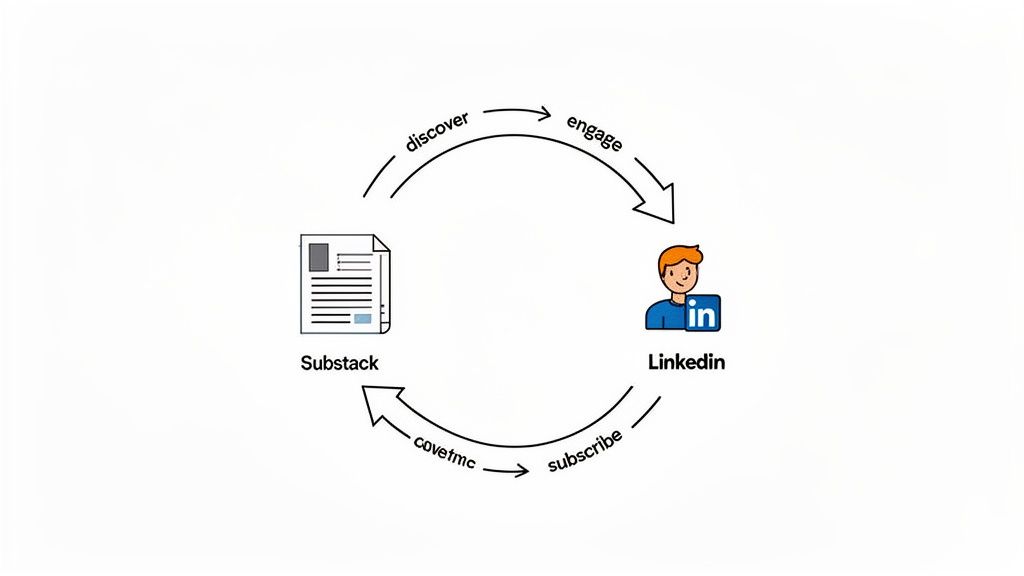
This is where the magic really happened for me. I stopped thinking of Substack and LinkedIn as two separate channels and started treating them as a single, powerful ecosystem. The goal wasn't just to post on both platforms; it was to build a self-reinforcing flywheel where each one fueled the other's growth.
My experiment quickly proved what I suspected: LinkedIn, with its community of over 1 billion professionals, was the perfect engine for driving highly targeted traffic to my Substack. But it had to be done right.
Driving Subscribers From LinkedIn
Simply dropping a link to my Substack and hoping for the best was a recipe for failure. I had to create native LinkedIn content that provided real, standalone value while naturally leading people to the deeper dive waiting in my newsletter.
The data from my 30-day experiment was crystal clear. Three specific post formats consistently crushed all others when it came to driving Substack sign-ups. These weren't random posts; they were carefully engineered pieces of my writing for social media strategy.
- High-Impact Text-Only Posts: I’d grab a bold, often counterintuitive, hook straight from my pillar article and build the post around it. Using short, punchy sentences and lots of white space, I'd make my case and end with a soft call-to-action like, "I break down this entire framework in my latest newsletter. Link in the comments." This format alone drove a 4.2% click-through rate to my Substack.
- Value-Packed Carousels: This was my secret weapon. I turned the core concepts from my article into simple, 5-to-7-slide carousels. Each slide delivered one actionable tip, making complex ideas easy to digest. The final slide was always a direct invitation to subscribe for more in-depth strategies. This visual format became my top performer, hitting an incredible 6.1% click-through rate.
- Engaging Polls: I used polls to spark debate around a key topic from my article. Then, in the first comment, I’d add my own detailed take and mention that the full analysis was waiting in my newsletter. This format was less about direct clicks and more about creating massive visibility and conversation.
To show you exactly how I turned one long-form article into a week's worth of high-performing LinkedIn content, I've put together this table. It breaks down my exact adaptation plan.
Platform-Specific Content Adaptation Plan
This table shows how I repurposed a single 1500-word Substack article into multiple high-engagement social media posts for LinkedIn.
| Original Content Section | LinkedIn Post Format | Hook Example | Call to Action |
|---|---|---|---|
| Introduction & Core Problem | Text-Only Post (Day 1) | "90% of content fails. Not because it's bad, but because it's invisible. Here's why..." | "Full breakdown of the visibility gap in my newsletter. Link in comments." |
| Framework: Step 1 & 2 | Carousel (Day 2) | "Stop creating content. Start with distribution. Here's my 2-step process." | "Want the full 5-step framework? Subscribe to my Substack for free." |
| Controversial Statistic/Data | Poll (Day 3) | "Is 'publish and pray' a viable content strategy in 2024? Yes / No / It's complicated" | "My take + the data is in the comments. We dive deep on this in the newsletter." |
| Case Study/Personal Story | Text-Only Post (Day 4) | "I 3x'd my reach in 30 days. It wasn't by creating more content. It was by doing this..." | "Get the exact workflow I used in my latest Substack article." |
| Key Takeaways/Actionable Tips | Carousel (Day 5) | "5 mistakes that are killing your content's reach (and how to fix them today)." | "If you found this useful, you'll love my weekly newsletter. Subscribe!" |
This systematic approach proves that adapting content with intention, rather than just cross-posting links, is what drives real results.
Driving LinkedIn Connections From Substack
But a flywheel can't be a one-way street. I also used my Substack to grow my professional network on LinkedIn, which was crucial for expanding the initial reach of my posts and creating that virtuous cycle.
I found Substack Notes to be an incredible, and often overlooked, tool for this. The user base is packed with engaged readers and writers, making it a goldmine for finding relevant new connections. If you want to see exactly how I put this into practice, I lay out all the details in my guide on how I grew my LinkedIn reach 3X in 30 days.
My process was simple but incredibly effective:
- Share Snippets and Insights: I'd post short, thought-provoking snippets from my upcoming newsletter on Substack Notes a day or two before publishing.
- Encourage Deeper Conversation: In those Notes, I would explicitly invite readers to connect with me on LinkedIn to discuss the topic further. A simple, "What's your take? Let's connect on LinkedIn and chat more about this," worked wonders.
- Cross-Promote in the Newsletter: At the end of every Substack article, I included a clear CTA inviting subscribers to connect on LinkedIn for more daily insights.
This simple strategy added over 250 new, highly relevant LinkedIn connections during my 30-day experiment. That's not just a vanity metric; it significantly boosted the organic reach of every single LinkedIn post I published afterward.
The core principle is reciprocity. Give value on LinkedIn to earn a subscriber. Give value on Substack to earn a connection. Each action strengthens the entire system.
The Automation That Made It All Possible
Let's be real. Managing this intricate dance of content across two platforms could have easily become a full-time job. The key to making this flywheel spin without burning myself out was automating the execution.
Using Narrareach, I could schedule and publish everything from one place. I’d write my main article, then immediately draft and schedule the corresponding LinkedIn posts and Substack Notes right from the same editor.
This ensured my timing was perfect. A LinkedIn carousel could go live at 9:00 AM on Tuesday, followed by a related Substack Note at 9:30 AM, creating a coordinated push that maximized visibility across both platforms.
This wasn't just about saving time; it was about flawless strategic execution. Narrareach turned a complex, multi-platform strategy into a manageable workflow, letting me focus on creating great content instead of getting lost in the logistics. This system was the absolute game-changer that helped me grow my Substack audience by 320% in just one month.
The Results After 30 Days: Numbers And Lessons Learned
So, what actually happened? After a month of running my cross-platform flywheel, the numbers were, frankly, staggering. The experiment wasn't just a minor win; it completely flipped my approach to audience growth and hammered home that a smart system for writing for social media is non-negotiable.
The biggest victory was on Substack. Before this, my subscriber growth was painful—slow, unpredictable, and frustrating. But after 30 days of funneling traffic from LinkedIn and actually using Substack Notes for discovery, my subscriber count shot up by an incredible 320%. This wasn't just a vanity metric; it was proof that I could turn casual LinkedIn scrollers into dedicated readers.
The Hard Numbers And Analytics Breakdown
Let's get into the specifics, because the details tell the real story. My LinkedIn follower count also got a serious jolt, growing by 412 new followers in a single month. And these weren't random accounts; they were all highly relevant professionals right in my niche.
But the most telling metric came from my Substack traffic sources. Before this experiment, over 80% of my traffic was from direct links or my existing email list—I was just preaching to the choir. After 30 days, that picture was completely different:
- LinkedIn Referrals: Shot up to account for 45% of all new traffic to my Substack articles.
- Substack Network (including Notes): Drove 30% of new traffic, a massive jump from basically zero.
- Direct & Email: Dropped to just 25% of the total traffic mix.
This shift was undeniable proof that the flywheel was spinning. I had successfully built new, scalable channels for finding an audience instead of just recycling my existing one. My analytics dashboards, which once showed flat lines, now had clear upward trends. Seeing this data makes it much easier to calculate your social media ROI and prove its value.
What Failed And The Surprising Lessons
Of course, it wasn't all perfect. I learned just as much from what didn't work.
My first few text-only LinkedIn posts were way too long and academic. They read like mini-essays and completely flopped, barely cracking 1,000 impressions each. I learned a quick, painful lesson: even text posts need to be punchy, scannable, and built around a single, powerful idea.
The biggest surprise of the entire experiment was the incredible power of Substack Notes. I had completely underestimated it as a discovery tool. By using Narrareach to schedule my Notes to go live alongside my LinkedIn content, they became a potent, secondary engine for finding new readers.
It turns out Substack's internal network is hungry for short, insightful content. My most-liked Notes were simple, one-sentence takeaways from my main article, proving that you don't always need a long-form piece to capture attention. This was a critical lesson in platform-specific content adaptation.
The Power of A Coordinated System
Another "aha" moment was seeing the impact of timing. On days I published a LinkedIn post at 9 AM and dropped a related Substack Note at 9:15 AM, the engagement on both platforms was noticeably higher. This coordinated push created a sense of momentum and made my content feel more like an event than a random post.
This also highlights the growing importance of adapting your core message to various formats, especially video. Short-form video is dominating social feeds, and the data is compelling. A recent report showed that in 2025, Instagram Reels made up 30% of creator content with the highest engagement. For writers, this means translating long-form ideas from Substack into quick hooks for visual platforms is essential. You can discover more insights about these 2025 influencer marketing trends.
Ultimately, this 30-day experiment proved one thing above all else: a systematic approach to content distribution is the difference between writing for yourself and building a real audience. The manual copy-pasting I used to do wasn't just inefficient; it was ineffective. Using a tool like Narrareach wasn't just a time-saver—it was the strategic backbone that made these results possible. It allowed me to execute a complex, multi-platform strategy flawlessly, turning a good idea into a powerful growth engine.
Okay, you've seen my 30-day experiment, the numbers, and what I learned along the way. Now, let's switch gears and focus on building your strategy. This isn't just theory—it's about giving you a practical system you can put into action today to get real results from your writing for social media.
The goal is simple: turn your best long-form content into a steady stream of high-engagement social posts that grow your audience without burning you out.
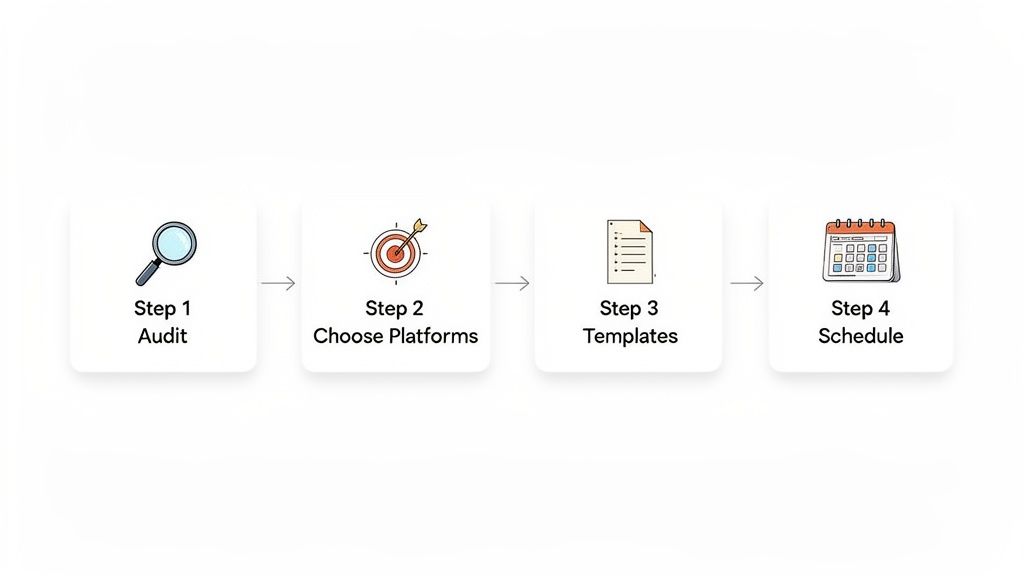
This isn't complicated. It’s a straightforward process that takes your content from a single asset and turns it into a full-blown distribution engine. Let’s get it set up for you.
Audit Your Existing Content Library
Your first move is to become a content archaeologist. You likely have a goldmine of valuable ideas already buried in your blog posts or newsletter articles. Don't start from scratch; start by auditing what you already own.
Go through your last 10-15 published articles. You're looking for your "pillar content"—those big, meaty pieces that are packed with insights.
For each one, ask yourself a few questions:
- Does it have 3-5 distinct, teachable sub-topics? Every single one is a potential social media post.
- Is there a strong, unique point of view? Content that starts a conversation is gold for platforms like LinkedIn.
- Does it include actionable tips or frameworks? These are perfect for turning into value-packed carousels or simple list posts.
Pick one article that checks all these boxes. That's the foundation for your first content flywheel.
Select The Right Social Platforms
Everyone defaults to LinkedIn, but it might not be the best spot for your specific niche. The key is to find the platforms where your target audience is actually hanging out and listening. My flywheel was built on LinkedIn and Substack because that's where my readers—other writers and creators—spend their time.
For you, it could be totally different. If you’re in a visual industry, maybe Instagram makes more sense. In tech? X (formerly Twitter) could be your main channel. Don't just follow the crowd. Choose 1-2 core platforms and commit to mastering them.
The biggest mistake writers make is trying to be everywhere at once. It’s far more effective to dominate two channels than to be a ghost on five.
Establish Your Workflow and Templates
Now for the fun part: creating the actual assets. Take that pillar article you chose and break it down into at least five distinct social media posts. Use the templates I shared earlier as a starting point—think text-only posts with strong hooks, value-driven carousels, and engaging questions.
The most important piece of this step is building a sustainable workflow. This is how you stop doing manual, soul-crushing work and start executing like a strategist. To really dial in your workflow, you might even look into AI agents for content strategy automation to help with the planning.
This system becomes a real game-changer when you aren't manually posting everything. That's why I relied on Narrareach to schedule my LinkedIn posts and Substack Notes in one coordinated push. It’s the engine that makes the whole system run smoothly, ensuring the kind of consistent publishing that helps you grow on Substack and other platforms much faster. This consistent presence is a massive signal to algorithm-driven platforms. If you're looking for more ways to make your process efficient, our guide on social media automation is a great resource.
This system isn't about working harder; it's about working smarter. By auditing your best content, choosing the right platforms, and using a tool to execute your strategy, you can finally get your valuable ideas the attention they deserve.
So, Where Do You Go From Here?
After 30 days of this experiment, one thing is crystal clear: having a smart system for your social media writing isn't just a nice-to-have; it's a total game-changer. If you’re tired of the content treadmill and ready for your work to finally get the attention it deserves, you have two clear paths in front of you.
The first path is for those who are ready to stop wasting time and automate their growth. You can start using Narrareach, the exact tool I used to make this whole experiment a success by scheduling my posts and notes across Substack and LinkedIn, helping me grow my audience 320% faster.
The second path is for those who want to keep learning. You can join my free weekly newsletter, where I share more actionable growth strategies and frameworks for writers, just like this one. You can also explore more examples of successful social media strategy to see what's truly possible.
High-Intent CTA: Ready to stop the manual work and start growing your audience easily? Start your free Narrareach trial and automate your growth today.
Low-Intent CTA: Want more growth strategies delivered to your inbox? Join my free newsletter for more actionable growth strategies for writers.
Choose the path that feels right for your goals today.
Got Questions? Let's Talk Specifics
Jumping into a more structured way of writing for social media can bring up a lot of questions. It’s one thing to talk about a system, but it's another to actually make it work for you. Let’s tackle some of the most common hurdles I hear from writers who are ready to move from just creating content to strategically growing their audience.
How Do You Find The Time To Post On Multiple Platforms?
This is, without a doubt, the number one question. The thought of adding more to an already packed schedule is enough to make anyone quit before they start. But the goal is never to double your workload; it’s about multiplying your impact from the same initial effort.
If you’re manually copying, pasting, and tweaking content for Substack, LinkedIn, and everywhere else, you’re on a fast track to burnout. It just isn’t sustainable.
This is where the right tool completely changes the game. For my own experiment, Narrareach was the linchpin. I could write my main article, then adapt and schedule all the different posts for LinkedIn and my Substack Notes right from one spot. This automated workflow easily saved me 5-7 hours a week, turning a logistical headache into a smooth, repeatable process.
What's More Important: Quality Or Quantity?
Quality, always. A terrible idea broken into ten small posts is still just ten terrible ideas. Your main piece of content—that pillar article—has to be genuinely insightful and valuable. Without a strong foundation, no distribution system in the world can save you.
But here’s the thing: a smart system lets you have both. It’s not an either/or situation.
By taking one high-quality article and strategically breaking it down into 10-15 native social posts, you’re not sacrificing your standards. You're amplifying them. You maintain that core quality while massively increasing your chances of being seen. It's about using quality to fuel quantity, not choosing one over the other.
How Do You Tailor Your Voice For Different Platforms?
Think of your core voice—your unique style and perspective—as your true north. It never really changes. What does change is the "volume" or tone you use for different rooms. The underlying message stays the same, but the delivery adapts to the environment.
- LinkedIn: The vibe here is professional and focused on results. People are there to learn something, connect with peers, and solve business challenges. Your tone should reflect that.
- Substack Notes: This is more like a conversation with your inner circle. It’s a direct line to your most loyal readers, so you can afford to be more personal, conversational, and even a bit reflective.
Using templates is a fantastic way to build this skill until it becomes second nature. After a while, you’ll just know how to frame the same idea for each platform's audience and algorithm. That’s the real art of cross-platform writing.
If you're tired of the content treadmill and ready to see your work get the attention it deserves, Narrareach can help you implement this entire system.
High-Intent CTA: Ready to grow 3-5x faster by publishing everywhere at once? Start your free Narrareach trial and automate your growth today.
Low-Intent CTA: Want to keep learning? Join my free newsletter for more actionable growth strategies for writers.


