How to Schedule Full Articles to Substack and Medium from One Editor in 2026
You can schedule full articles to both Substack and Medium from one editor using Narrareach, then automatically distribute them across LinkedIn, X, Bluesky, and Threads. This unified workflow eliminates the need to manually copy content between platforms, saving writers 3-5 hours per week while reaching audiences across multiple channels simultaneously.
Why Multi-Platform Article Publishing Matters in 2026
Content creators who publish across multiple platforms see 73% higher engagement rates compared to single-platform publishers, according to recent data from the Content Marketing Institute. The fragmented media landscape means your audience exists across different platforms—some prefer Substack's newsletter format, others discover content through Medium's algorithm, and many engage primarily on social media.
The Cost of Manual Cross-Posting
Publishing manually to each platform creates significant time overhead. A typical workflow involves:
- Writing in one platform's editor (30-60 minutes)
- Copying and reformatting for Medium (10-15 minutes)
- Creating social media snippets (15-20 minutes per platform)
- Scheduling posts across 3-4 social channels (20-30 minutes)
This totals 75-125 minutes per article. For writers publishing twice weekly, that's 2.5-4 hours of repetitive formatting work.
Platform-Specific Audience Benefits
Substack excels at building direct subscriber relationships, with average open rates of 43.8% compared to traditional email marketing's 21.3%. Medium drives discovery through its recommendation algorithm, generating an average of 150-300 additional views per article for active publishers. Social platforms like LinkedIn see 5x higher engagement for content that includes article previews compared to standalone posts.
Understanding the Unified Publishing Workflow
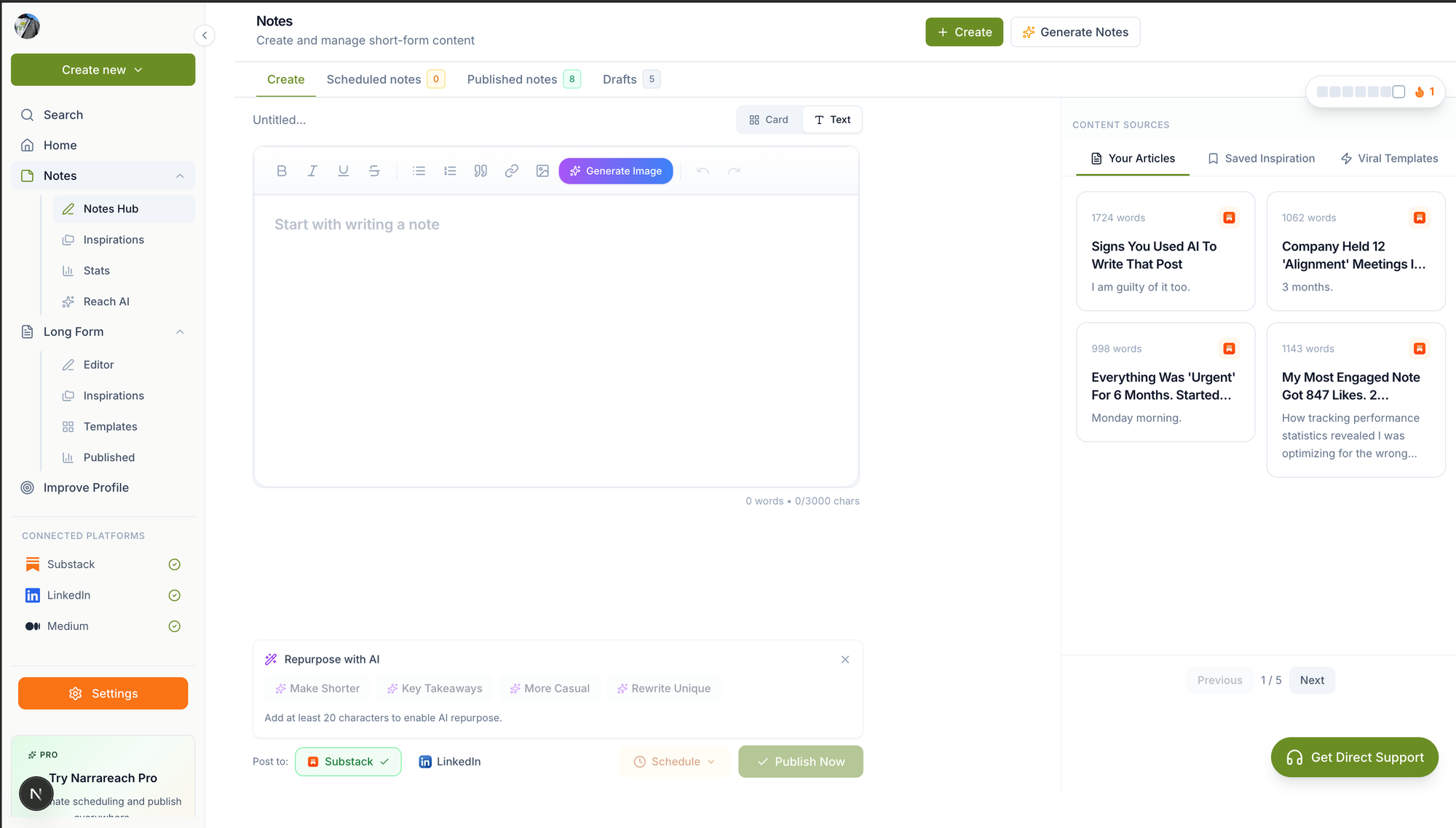
The most efficient approach involves writing once in a central editor, then distributing to both long-form platforms (Substack and Medium) and social channels simultaneously. Narrareach's Substack Notes scheduler extends this concept by treating your article as the foundation for multiple content formats.
The Substack-First Strategy
Starting with Substack as your primary platform offers several advantages. Substack's editor handles rich formatting, embedded media, and subscriber management. Once your article is complete, you can schedule it for publication while simultaneously preparing shortened versions for Medium and social distribution.
Content Adaptation Across Platforms
Each platform has distinct formatting requirements and audience expectations. Substack articles can include subscriber-only sections and newsletter-specific calls-to-action. Medium versions should focus on broader appeal and include relevant tags for discoverability. Social snippets need compelling hooks and clear value propositions within character limits.
Step-by-Step: Setting Up Your Multi-Platform Publishing System
Step 1: Connect Your Publishing Accounts
Begin by linking your Substack, Medium, LinkedIn, X, and other social accounts through Narrareach integrations. This one-time setup enables seamless publishing across all platforms without repeatedly entering credentials.
Step 2: Create Your Master Article
Write your full article in Narrareach's unified editor. Include all rich formatting, images, and embedded content. The editor automatically optimizes formatting for each target platform during distribution.
Step 3: Configure Platform-Specific Settings
Customize how your article appears on each platform:
- Substack: Set publication timing, subscriber-only sections, and newsletter-specific CTAs
- Medium: Choose relevant publications, tags, and canonical URL settings
- Social platforms: Create platform-optimized excerpts and hashtag strategies
Step 4: Schedule Coordinated Publication
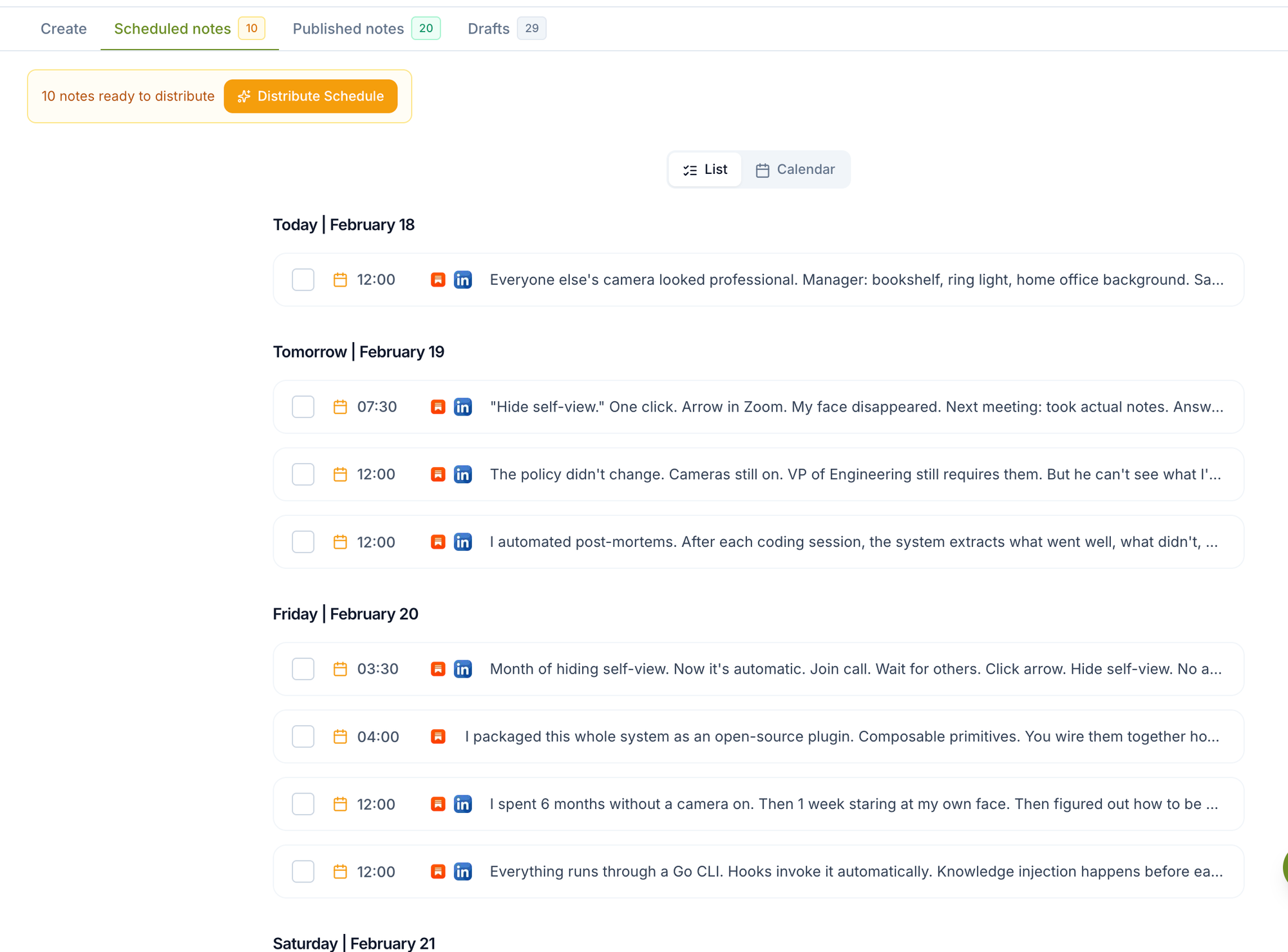
Set your publication timeline. Best practice involves publishing to Substack first (to prioritize subscriber value), followed by Medium 2-4 hours later, then social promotion throughout the following 24-48 hours.
Step 5: Monitor Cross-Platform Performance
Track engagement metrics across all platforms to understand which content types perform best on each channel. This data informs future content strategy and timing optimization.
Platform-Specific Optimization Strategies
Substack Optimization
Substack rewards consistency and subscriber engagement. Schedule articles for your audience's peak reading times—typically Tuesday through Thursday, 6-9 AM or 7-9 PM in your subscribers' time zones. Include subscriber-only content to drive conversions, and use clear section breaks for mobile readability.
Medium Optimization
Medium's algorithm favors articles with strong initial engagement. Publish during Medium's peak traffic hours (Monday-Thursday, 7-9 AM EST) and include 3-5 relevant tags. Use compelling subtitles and include a clear value proposition in your first paragraph to capture reader attention quickly.
Social Media Distribution
Each social platform requires tailored approaches. Cross-post Substack to LinkedIn using professional language and industry-relevant hashtags. X posts should include compelling hooks and thread potential. Bluesky and Threads benefit from more conversational tones and community engagement.
Competitor Analysis: Multi-Platform Publishing Tools
Native Platform Editors
Pros: Full feature access, no third-party dependencies, platform-specific optimization tools
Cons: Requires manual copying between platforms, no unified scheduling, time-intensive workflow
Buffer and Hootsuite
Pros: Established social media scheduling, analytics dashboards, team collaboration features
Cons: Limited long-form content support, no Substack integration, separate tools needed for newsletter platforms
Narrareach
Pros: Unified editor for all platforms, Substack-first workflow, automatic formatting optimization, integrated social distribution
Cons: Newer platform with evolving feature set, requires learning new interface
Time-Saving Calculations: Manual vs. Automated Publishing
Consider a content creator publishing 8 articles per month across Substack, Medium, LinkedIn, and X:
Manual workflow:
- 8 articles × 4 platforms × 15 minutes formatting = 480 minutes (8 hours)
- 8 articles × 4 social posts × 5 minutes scheduling = 160 minutes (2.7 hours)
- Monthly total: 640 minutes (10.7 hours)
Narrareach workflow:
- 8 articles × 1 unified editor × 5 minutes setup = 40 minutes
- 8 articles × 1 distribution setup × 3 minutes = 24 minutes
- Monthly total: 64 minutes (1.1 hours)
Time saved: 9.6 hours per month, or 115 hours annually—equivalent to nearly three full work weeks.
Advanced Workflow Strategies
Content Batching and Calendar Planning
Maximize efficiency by batching content creation. Write 4-6 articles in focused sessions, then schedule them across 2-3 weeks. This approach maintains consistent publishing while reducing context-switching overhead.
Audience-Specific Customization
Tailor your message for each platform's audience while maintaining core content consistency. Substack subscribers prefer in-depth analysis, Medium readers seek actionable insights, and social media audiences want quick, shareable takeaways.
Performance-Based Optimization
Use cross-platform analytics to identify your best-performing content types and publication times. Articles that perform well on one platform often succeed on others with proper formatting adjustments.
Getting Started: Your First Week with Multi-Platform Publishing
Day 1-2: Account Setup and Integration
Connect your Substack, Medium, and social media accounts to Narrareach. Verify all integrations work correctly by publishing a test post to each platform.
Day 3-4: Content Planning and Creation
Plan your first week's content calendar. Create 2-3 articles using the unified editor, experimenting with different formatting options and platform-specific customizations.
Day 5-6: Schedule and Optimize
Schedule your articles across all platforms, staggering publication times for maximum reach. Set up social media promotion posts to drive traffic back to your long-form content.
Day 7: Monitor and Adjust
Review performance metrics across all platforms. Note which content types and publication times generate the best engagement, and adjust your strategy accordingly.
Common Challenges and Solutions
Maintaining Content Quality Across Platforms
Avoid the temptation to simply copy-paste identical content. Each platform benefits from slight modifications that respect audience expectations and platform norms while maintaining your core message.
Managing Publication Timing
Coordinate publication schedules to avoid overwhelming your audience while maximizing reach. Space out social media posts promoting the same article by 6-12 hours to capture different audience segments.
Handling Platform-Specific Technical Requirements
Different platforms have varying image size requirements, character limits, and formatting restrictions. A unified publishing tool handles these technical details automatically, ensuring optimal presentation across all channels.
Measuring Success Across Multiple Platforms
Key Performance Indicators
Track meaningful metrics for each platform: Substack subscriber growth and open rates, Medium claps and follower increases, social media engagement rates and click-throughs. Focus on metrics that indicate genuine audience growth rather than vanity numbers.
Cross-Platform Attribution
Use UTM parameters and platform analytics to understand how readers discover your content and move between platforms. This data helps optimize your distribution strategy and identify your most valuable traffic sources.
Future-Proofing Your Publishing Strategy
Adapting to Platform Changes
Social media algorithms and platform features evolve constantly. A flexible publishing system allows quick adaptation to new requirements without rebuilding your entire workflow.
Scaling Your Content Operation
As your audience grows, efficient publishing becomes even more critical. Automated distribution systems scale effortlessly, allowing you to focus on content quality rather than repetitive posting tasks.
Ready to streamline your multi-platform publishing workflow? Explore Narrareach pricing to find the plan that fits your publishing needs and start saving hours each week while reaching more readers across every platform.
Visual Walkthrough