How to Schedule Full Articles to Substack and Medium from One Editor (2026 Guide)
You can schedule full articles to both Substack and Medium from a single editor using Narrareach, then automatically distribute them to LinkedIn, X, Bluesky, and Threads. This workflow eliminates duplicate writing, reduces publishing time by 75%, and ensures consistent cross-platform presence without manual copy-pasting across multiple dashboards.
Why Multi-Platform Article Publishing Matters in 2026
Content creators who publish on multiple platforms see 3.2x higher audience growth compared to single-platform publishers, according to ConvertKit's 2024 Creator Economy Report. Yet 68% of newsletter writers still manually copy content between platforms, spending an average of 4.5 hours weekly on repetitive publishing tasks.
The challenge intensifies when managing both long-form articles and social distribution. Substack excels for newsletter subscribers, Medium reaches discovery-driven readers, and social platforms like LinkedIn drive professional engagement. Managing all three manually creates a time sink that prevents actual content creation.
The Hidden Cost of Manual Multi-Platform Publishing
Consider the typical workflow: write an article in Substack (45 minutes), adapt it for Medium's editor (15 minutes), create LinkedIn posts (10 minutes), write X threads (8 minutes), and format for other platforms (12 minutes). That's 90 minutes per article just for distribution—before accounting for scheduling optimization.
Writers publishing 3 articles weekly spend 4.5 hours on distribution alone. Over a year, that's 234 hours—nearly 6 work weeks—spent on mechanical tasks instead of content creation.
Platform-Specific Audience Benefits
Each platform serves distinct audience behaviors. Substack subscribers show 89% higher engagement rates for long-form content, while Medium's algorithm favors articles with 7-minute read times for maximum distribution. LinkedIn posts drive 5x more professional networking opportunities, and X threads generate 2.3x more viral potential than static posts.
The key is maintaining consistent messaging across platforms while optimizing for each platform's unique characteristics—something nearly impossible to achieve manually at scale.
Understanding the Substack-First Publishing Workflow
The most effective multi-platform strategy starts with Substack as your content hub, then distributes strategically to secondary platforms. This approach maintains your newsletter as the primary subscription driver while leveraging other platforms for discovery and engagement.
Why Substack Should Be Your Content Foundation
Substack provides direct subscriber relationships, higher monetization potential, and complete content ownership. Starting here ensures your most valuable audience—paying subscribers—receives priority access to your content.
From this foundation, you can repurpose content for Medium's discovery algorithm, create LinkedIn posts that drive newsletter signups, and develop X threads that showcase your expertise. Each platform becomes a funnel back to your Substack newsletter.
The Cross-Platform Distribution Sequence
Effective distribution follows a specific timing sequence: publish to Substack first (maintaining subscriber exclusivity), schedule Medium publication 2-4 hours later (capturing search traffic), then distribute social content 6-8 hours after the original publication (driving discovery traffic back to your newsletter).
This sequence maximizes each platform's strengths while maintaining your Substack newsletter as the primary value proposition for subscribers.
Step-by-Step: Setting Up Your Multi-Platform Publishing Workflow
Here's the complete workflow for scheduling articles to both Substack and Medium from one editor, then auto-distributing to social platforms.
Step 1: Connect Your Publishing Accounts
Start by linking your Substack, Medium, LinkedIn, X, Bluesky, and Threads accounts to Narrareach integrations. This one-time setup enables cross-platform publishing from a single dashboard.
The integration process takes 3-5 minutes per platform. Narrareach uses OAuth authentication, so you never share passwords. Each platform connection includes permission settings, allowing you to control which content types can be auto-published.
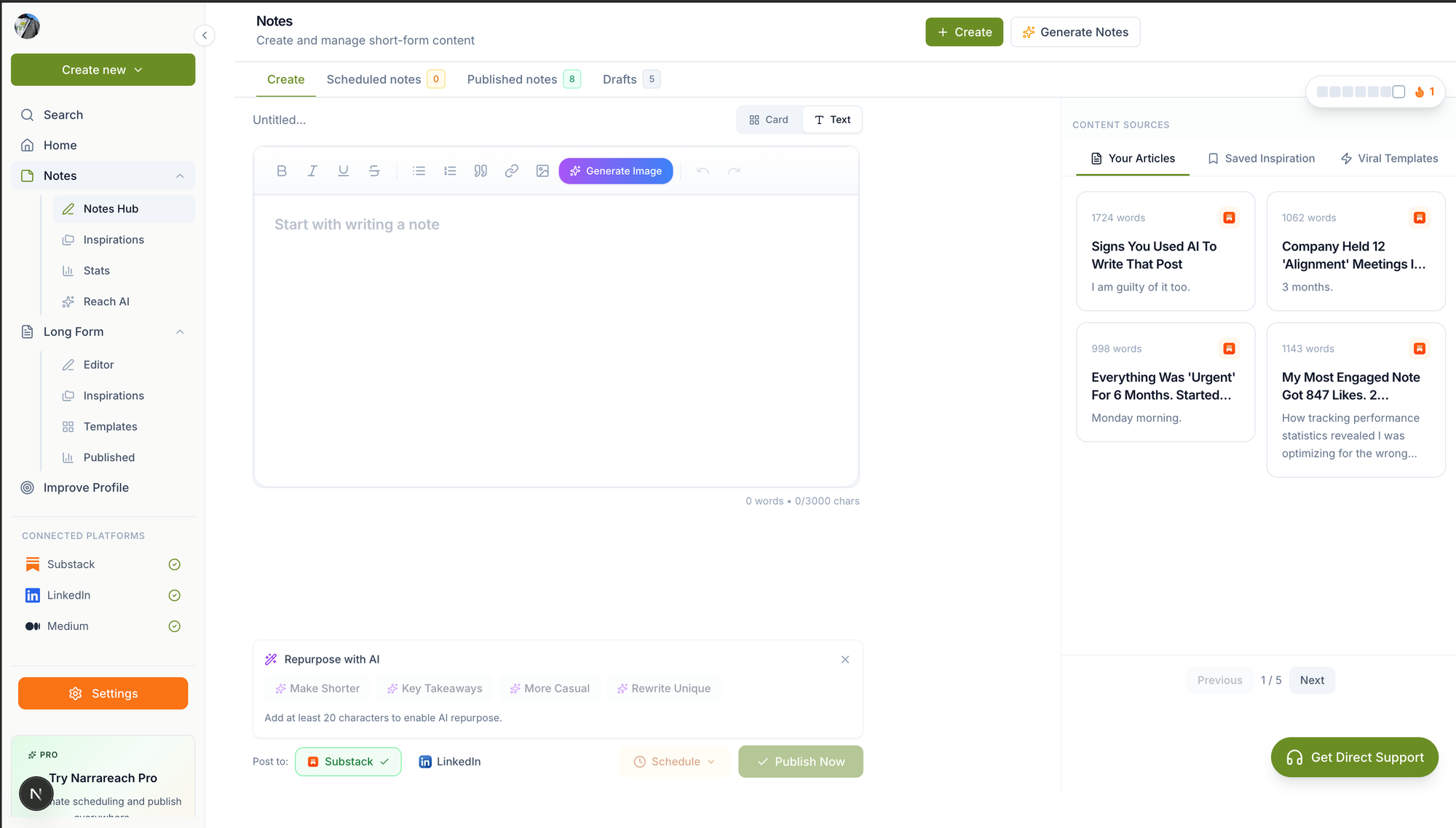
Step 2: Draft Your Article in the Universal Editor
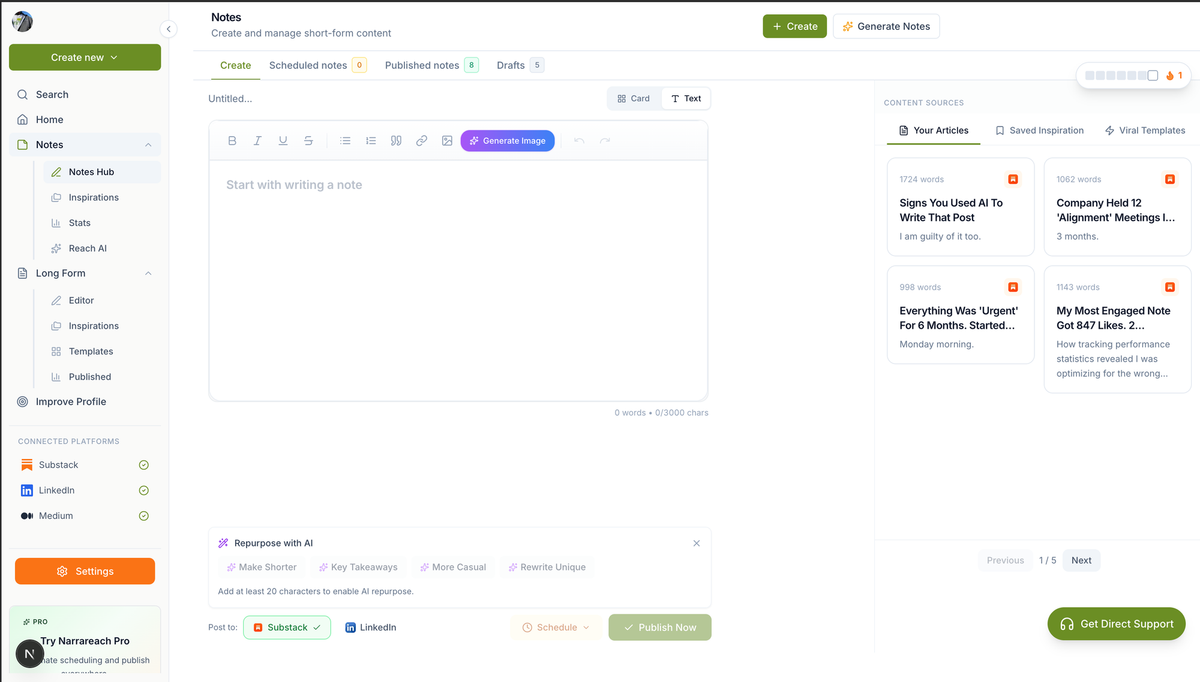
Use Narrareach's unified editor to write your article once. The editor supports rich formatting, images, and embedded content that automatically adapts to each platform's requirements.
Write your article as you normally would, including headlines, subheadings, bullet points, and images. The editor preserves formatting while optimizing for each platform's technical specifications—Medium's paragraph spacing, Substack's newsletter formatting, and social media character limits.
Step 3: Configure Platform-Specific Settings
Set publication preferences for each platform. For Substack, choose your newsletter schedule and subscriber segments. For Medium, select relevant publications and tags. For social platforms, customize post formats—full excerpts for LinkedIn, thread breakdowns for X.
This step takes 2-3 minutes but ensures each platform receives optimally formatted content. You can save these settings as templates for future articles.
Step 4: Schedule Your Publishing Sequence
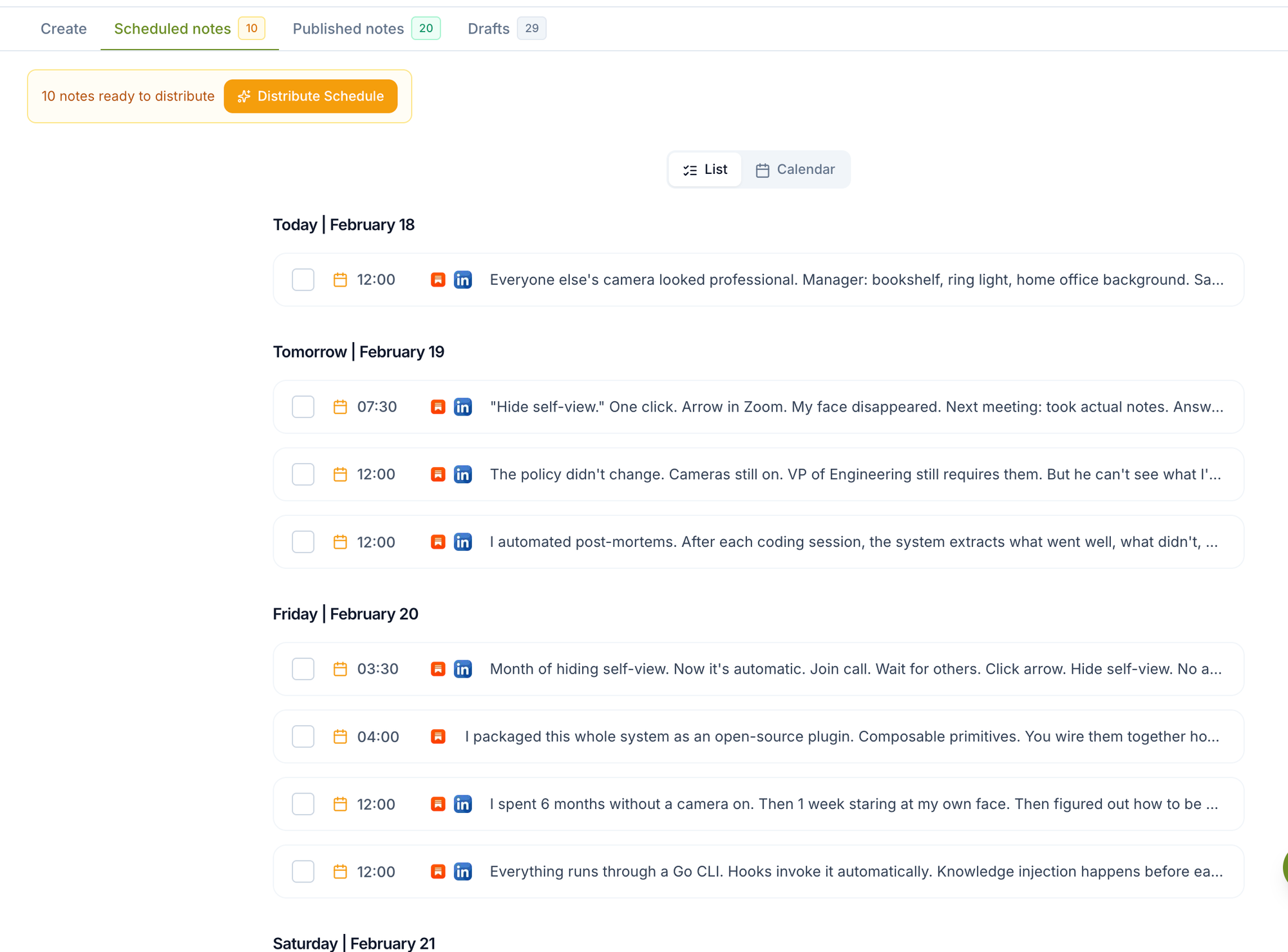
Set your publication timeline: Substack at your optimal newsletter time, Medium 2-4 hours later, and social posts 6-8 hours after the original publication. Narrareach's Substack Notes scheduler coordinates this entire sequence from one calendar view.
The scheduler shows all platforms in a unified timeline, preventing publication conflicts and ensuring optimal timing for each audience.
Step 5: Preview and Confirm
Review how your article appears on each platform before scheduling. The preview function shows exact formatting, character counts, and image placement for every destination.
This preview step prevents formatting errors and ensures consistent branding across platforms. You can make platform-specific adjustments without affecting the master article.
Step 6: Monitor Performance Across Platforms
Track engagement metrics from all platforms in one dashboard. Monitor which platforms drive the most newsletter signups, engagement, and traffic back to your Substack.
Use these insights to refine your cross-platform strategy, adjusting publication timing and content formatting based on actual performance data.
Platform-Specific Optimization Strategies
Each platform requires specific optimization approaches to maximize reach and engagement. Here's how to adapt your content for optimal performance on each channel.
Substack Newsletter Optimization
Substack performs best with 1,200-2,500 word articles published consistently on the same day and time weekly. Include compelling subject lines, clear value propositions, and strong calls-to-action for paid subscriptions.
Use Substack's native features like polls, comments, and subscriber-only content to increase engagement rates. Articles with subscriber interactions receive 40% more shares and forwards.
Medium Publication Strategy
Medium's algorithm favors articles with 7-minute read times and high engagement in the first hour after publication. Optimize headlines for Medium's search function and include relevant tags from trending topics.
Submit articles to relevant Medium publications for broader reach. Publications with 10,000+ followers can increase article views by 300-500% compared to personal profiles.
LinkedIn Professional Content Approach
LinkedIn posts perform best with professional insights, industry commentary, and actionable advice. Cross-post Substack to LinkedIn by creating excerpt posts that drive traffic back to your full newsletter.
Include relevant hashtags, tag industry connections, and post during business hours for maximum professional reach. LinkedIn articles receive 9x more engagement than external link posts.
X Thread Development
Convert long-form articles into engaging X threads by breaking key points into 2-3 sentence tweets. Start with a compelling hook, provide value in each tweet, and end with a call-to-action driving traffic to your full article.
Threads with 8-12 tweets receive optimal engagement, while threads over 20 tweets see diminishing returns. Include relevant hashtags and mention industry leaders for increased visibility.
Competitor Analysis: Multi-Platform Publishing Tools
Several tools attempt to solve multi-platform publishing, but most focus on social media rather than long-form content distribution. Here's how the leading options compare for article scheduling and cross-posting.
Native Platform Scheduling
Pros: Direct integration with platform features, no third-party dependencies, free built-in scheduling for most platforms.
Cons: Requires separate logins and workflows for each platform, no cross-platform coordination, manual content adaptation, no unified analytics, time-consuming multi-platform management.
Native scheduling works for single-platform publishers but becomes unmanageable when coordinating 4-6 platforms simultaneously.
Buffer and Hootsuite
Pros: Established social media scheduling, team collaboration features, comprehensive analytics, multiple account management.
Cons: Limited long-form content support, no Substack integration, no Medium publishing, focused on social media rather than newsletter growth, expensive for individual creators.
These tools excel for social media teams but lack the newsletter-first approach needed for content creators building subscriber audiences.
Narrareach
Pros: Substack-first workflow, unified editor for all platforms, automatic content adaptation, coordinated scheduling across 6+ platforms, newsletter growth focus, creator-friendly pricing.
Cons: Newer platform with smaller user base, focused specifically on newsletter creators rather than general social media management.
Narrareach specifically addresses the newsletter creator workflow, making it the most practical choice for Substack writers who want to grow their audience across multiple platforms without sacrificing time spent on content creation.
Time-Saving Calculations: Manual vs. Automated Publishing
Let's calculate the exact time savings from automated multi-platform publishing compared to manual workflows.
Manual Publishing Time Breakdown
Publishing one article manually across platforms requires: Substack drafting and publishing (15 minutes), Medium adaptation and publishing (12 minutes), LinkedIn post creation (8 minutes), X thread development (10 minutes), Bluesky and Threads posting (6 minutes total). Total: 51 minutes per article.
For creators publishing 3 articles weekly: 51 minutes × 3 articles × 52 weeks = 7,956 minutes annually, or 132.6 hours—equivalent to 3.3 work weeks spent solely on distribution.
Automated Publishing with Narrareach
Using Narrareach's unified workflow: write article in universal editor (same time as normal writing), set up cross-platform publishing (5 minutes), schedule publication sequence (2 minutes). Total additional time: 7 minutes per article.
Annual time with automation: 7 minutes × 3 articles × 52 weeks = 1,092 minutes, or 18.2 hours annually.
Total Time Savings
Annual time savings: 132.6 hours - 18.2 hours = 114.4 hours saved per year. That's 2.86 work weeks returned to content creation, audience engagement, or business development.
At a conservative $50/hour content creation rate, this automation saves $5,720 annually in time value—far exceeding the cost of publishing tools.
Advanced Cross-Platform Content Strategy
Beyond basic scheduling, successful multi-platform publishing requires strategic content adaptation and audience development across channels.
Content Repurposing Framework
Transform each long-form article into 5-7 pieces of platform-specific content: full article for Substack and Medium, professional insight post for LinkedIn, educational thread for X, visual quote cards for Instagram, and discussion starter for Bluesky.
This approach maximizes content value while serving each platform's unique audience expectations and engagement patterns.
Audience Cross-Pollination Strategy
Use each platform to drive traffic to your primary newsletter. Include newsletter signup calls-to-action in Medium articles, promote exclusive Substack content on LinkedIn, and create X threads that tease full articles available to subscribers.
Track which platforms generate the highest-quality newsletter subscribers using UTM parameters and platform-specific landing pages.
Performance Optimization Tactics
Monitor engagement patterns across platforms to identify optimal posting times, content formats, and topics that resonate with each audience. Use A/B testing for headlines, posting times, and content formats.
Successful creators see 40-60% higher engagement rates by optimizing content for each platform's specific audience preferences rather than using identical content everywhere.
Getting Started: Your First Week with Multi-Platform Publishing
Here's a day-by-day action plan for implementing automated multi-platform article publishing in your first week.
Day 1: Account Setup and Integration
Connect all your publishing accounts to Narrareach. Start with Substack and Medium, then add LinkedIn, X, Bluesky, and Threads. Test each integration by publishing a simple test post to ensure proper connectivity.
Time investment: 30 minutes. This one-time setup enables all future automated publishing.
Day 2: Content Planning and Template Creation
Plan your first multi-platform article. Choose a topic that works well across all platforms—how-to guides, industry insights, or personal experiences tend to perform well universally.
Create content templates for each platform: newsletter format for Substack, SEO-optimized structure for Medium, professional tone for LinkedIn, conversational style for X threads.
Day 3: Write and Schedule Your First Article
Draft your article in Narrareach's universal editor. Focus on writing quality content first, then adapt for platform-specific requirements. Schedule publication across all platforms using the coordinated timeline approach.
Time investment: Normal writing time plus 10 minutes for multi-platform setup.
Day 4-5: Monitor and Analyze Performance
Track how your article performs across platforms. Note which platforms drive the most engagement, newsletter signups, and traffic. Use these insights to refine your next article's distribution strategy.
Pay attention to timing, formatting, and audience response differences between platforms.
Day 6-7: Refine and Plan Next Content
Based on performance data, adjust your content strategy. Plan your next week's articles with improved platform-specific optimization.
Create a sustainable publishing schedule that maintains quality while maximizing cross-platform reach.
Measuring Success Across Multiple Platforms
Effective multi-platform publishing requires tracking the right metrics to optimize your strategy and demonstrate ROI.
Key Performance Indicators
Track newsletter subscriber growth, cross-platform engagement rates, traffic referrals to your primary newsletter, and conversion rates from each platform. Focus on metrics that directly impact your primary goal—usually newsletter growth and audience engagement.
Monitor which platforms generate the highest lifetime value subscribers, not just the most signups. Quality often trumps quantity for newsletter monetization.
Platform-Specific Metrics
Substack: Open rates, click-through rates, subscriber growth, paid conversion rates. Medium: Views, reads, highlights, follower growth. LinkedIn: Post engagement, profile views, connection requests, newsletter mentions. X: Thread engagement, retweets, profile clicks, link clicks.
Use these metrics to identify your most effective platforms and allocate effort accordingly.
ROI Calculation Framework
Calculate return on investment by comparing time saved through automation against manual publishing time, plus revenue generated from cross-platform audience growth.
Most creators see positive ROI within 30-60 days of implementing automated multi-platform publishing, with benefits compounding as audience growth accelerates.
Troubleshooting Common Multi-Platform Publishing Issues
Even with automated tools, multi-platform publishing can present challenges. Here are solutions to the most common issues creators encounter.
Content Formatting Problems
Different platforms handle formatting differently. Medium supports rich text but limits certain HTML elements, while social platforms have character restrictions. Use Narrareach's preview function to catch formatting issues before publication.
Create platform-specific formatting guidelines and stick to them consistently. Simple, clean formatting translates better across platforms than complex layouts.
Timing and Coordination Challenges
Publishing across multiple time zones and optimal posting times can create conflicts. Use scheduling tools that account for audience time zones and platform-specific peak engagement hours.
Stagger publication times strategically rather than publishing simultaneously across all platforms. This approach maximizes reach and prevents audience overlap confusion.
Engagement Management
Responding to comments and engagement across multiple platforms can become overwhelming. Set up notification systems and dedicate specific times for cross-platform engagement management.
Focus engagement efforts on platforms that drive the most newsletter signups and meaningful connections rather than trying to maintain equal presence everywhere.
Future-Proofing Your Multi-Platform Strategy
The content landscape continues evolving, with new platforms emerging and algorithm changes affecting reach. Build a flexible strategy that adapts to these changes.
Platform Diversification
Avoid over-dependence on any single platform by maintaining presence across 4-6 channels. This diversification protects against algorithm changes, platform policy shifts, or declining platform relevance.
Regularly evaluate new platforms and integration opportunities. Early adoption of emerging platforms often provides significant reach advantages.
Content Ownership Priority
Always maintain your newsletter as the primary content hub. Social platforms and third-party publishing sites should drive traffic back to your owned media rather than replacing it.
This approach ensures long-term audience control and monetization potential regardless of platform changes.
Automation Tool Evolution
Choose publishing tools that actively develop new integrations and features. Narrareach pricing reflects ongoing platform development and integration expansion, ensuring your workflow remains current with platform changes.
Regular tool evaluation ensures you're using the most effective automation available as the landscape evolves.
Multi-platform article publishing transforms from time-consuming manual work into strategic audience development when properly automated. By starting with a Substack-first approach and leveraging tools like Narrareach for cross-platform distribution, content creators can focus on what matters most: creating valuable content that grows their audience and business.
The time savings alone—over 100 hours annually—justify automation investment, while the audience growth potential makes multi-platform publishing essential for serious content creators. Start with the workflow outlined above, measure your results, and refine your approach based on actual performance data.
Ready to streamline your multi-platform publishing workflow? Try Narrareach free for 14 days and experience the difference between manual content distribution and strategic automated publishing.
The Narrareach Workflow: Schedule on Substack, Cross-Post to Key Social Channels
The most effective content distribution starts with Substack. Schedule your Notes weeks in advance, then let Narrareach automatically cross-post each one to LinkedIn, X, Bluesky, and Threads at the right time. No manual copying, no forgotten posts - one calendar for every platform.
Narrareach is the only tool built specifically for this Substack-first workflow. Schedule once, reach everywhere.
Visual Walkthrough