
Why Medium Internal Traffic Drops While External Traffic Grows
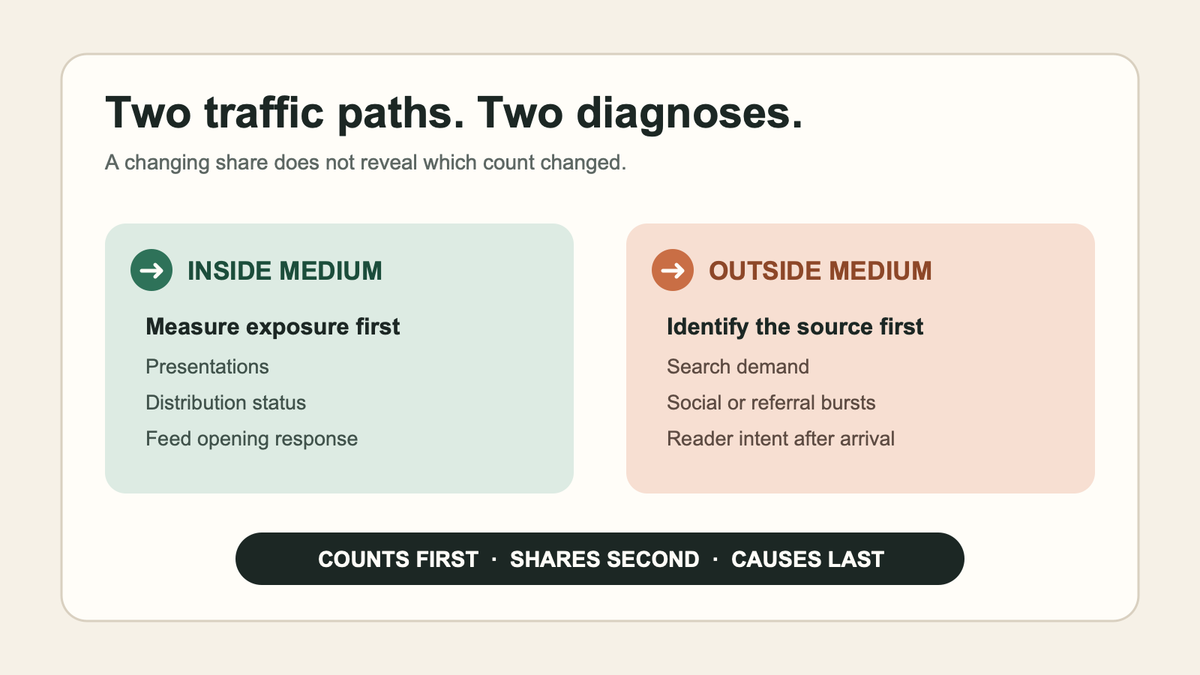
When Medium internal traffic drops while external traffic grows, do not assume Google, social sharing or cross-posting caused Medium to reduce distribution. The two paths can move independently. First check whether the count of Medium-sourced views and presentations actually fell. Then inspect distribution status, feed clickthrough, publication placement and topic fit. Separately, identify which outside source grew and whether that traffic is durable.
My view is that a growing external audience is an asset, not evidence of an algorithmic penalty. The practical mistake is treating a changing traffic share as proof that Medium “stopped pushing” a story. A percentage can fall even when the underlying count stays flat. Diagnose the two acquisition systems separately before changing the article, abandoning a useful search topic or leaving Medium. Narrareach can carry the resulting decision into the next draft and publishing pass; Medium still supplies the native source and distribution evidence.
The short diagnostic
| What changed? | What it may mean | Check next |
|---|---|---|
| Medium view count fell and external views stayed level | A real internal decline | Presentations, distribution status, publication placement and feed clickthrough |
| Medium views stayed level but external views rose | No internal loss; the mix changed | The outside source, query or referral that expanded |
| Presentations fell but feed clickthrough held | Less internal exposure to a similar response | Topic fit, follower/publication reach and distribution eligibility |
| Presentations held but feed clickthrough fell | The story was shown but opened less often | Title, subtitle, image and audience match |
| External traffic rose but reads did not | More arrivals with weaker intent or a poor landing experience | Source, opening, answer placement and paywall context |
| Both internal and external views fell | A broader demand or catalogue problem | Topic timing, publication cadence, source losses and comparable stories |
The important sequence is counts first, shares second, causes last. A source percentage describes composition. It does not identify a cause.
What Medium calls internal and external traffic
Medium's detailed story statistics show the percentage of views attributed to Medium's distribution, followed by the leading external sources. Medium distribution can include its website, apps, emails and other recommendation surfaces. External discovery can include search engines, social platforms, direct links and referrals from other sites.
Presentations are a separate measure. Medium defines them as times it suggested a story on its own website or app, or through email and push notifications, with stated exclusions. A presentation is an opportunity to open the story; it is not a view. An external visitor can land on the article without generating a Medium presentation.
That distinction explains why views can exceed presentations. Medium's Stats FAQ says a story that attracts substantial search or social traffic may record more views than presentations. It also explains why dividing all views by presentations will not reproduce feed clickthrough: Medium calculates that rate from openings attributed to feed presentations.
A falling internal share is not always falling internal traffic
Suppose a story received 500 Medium views and 100 external views in one period. Medium supplied 83.3% of the 600 total. In the next comparable period, Medium still supplied 500 views while external sources supplied 900. The Medium share fell to 35.7%, but internal traffic did not fall at all.
Now consider a different story:
| Period | Medium views | External views | Total views | Medium share |
|---|---|---|---|---|
| Earlier | 1,200 | 300 | 1,500 | 80.0% |
| Later | 700 | 900 | 1,600 | 43.8% |
Here the share fell and the Medium count fell by 500 views. External growth more than replaced the lost internal traffic, so total views rose by 100. A total-view chart alone would hide the distribution decline. A source-share chart alone would exaggerate the role of external growth. The counts reveal both events.
Use equal observation windows when making this comparison. Seven days after publication should be compared with seven days after publication, not with a previous story's lifetime result. For older evergreen work, compare matching months or rolling 28-day periods so search seasonality does not masquerade as a platform change.
Current Narrareach data shows how external-led stories can still accumulate readers
A Narrareach product-data check on September 19, 2026 found eight Medium stories with at least 10 lifetime views and usable per-story referrer data across two connected accounts. The saved story snapshots, refreshed between August 22 and September 15, contained 711 lifetime views. Medium accounted for 163 views, or 22.9% of the total. Named non-Medium referrers accounted for 546 views, and every one of the eight stories was externally led.
This is a small, self-selected product sample, not a Medium-wide benchmark. The stories have different ages and topics, and only the leading referrers saved with each story are included; two views were outside the named breakdown. The useful point is narrower: a low internal share can coexist with hundreds of externally sourced views. Source mix describes how the audience arrived. It does not, by itself, say whether the article is healthy, eligible for wider Medium distribution or economically valuable.
I would therefore preserve a story that is meeting durable search demand even when its internal share is modest. The better question is whether the external readers do what that article was built to support: cross the 30-second read threshold, follow, subscribe, continue to another piece or find the promised answer.
Diagnose a real decline in Medium distribution
If the Medium-sourced count actually fell, work through four checks in order.
1. Compare presentations before blaming the title
Presentations show whether Medium supplied opportunities to open the story. Compare recent stories with similar subjects, formats, follower bases and publication contexts. If presentations fell while feed clickthrough remained near the story's normal range, the first break is exposure. Rewriting the opening will not create a presentation.
If presentations held but feed clickthrough fell, inspect what readers saw before opening: title, subtitle, image, publication name and subject. Do not cycle through several title and image changes in quick succession. Medium warns that rapid changes are hard to interpret because each version may reach a different audience.
For a full treatment of the denominator and sample-size problem, see the guide to Medium read ratio and feed clickthrough.
2. Check the story's distribution category
Medium's current distribution guidelines describe three categories. Network Distribution is the baseline path to people who follow the writer or publication. General Distribution can match a story to readers by interests and related follows. Boost gives selected stories higher-priority distribution.
These categories govern discovery inside Medium. They do not prevent people from finding the same story through search engines, direct links or social platforms. A story can therefore have restricted internal reach and still grow externally.
Check for a Boost or publication badge and read the applicable guidelines. Avoid turning the result into a private-algorithm theory. Medium publishes eligibility and quality boundaries, but it does not provide a formula that lets a writer prove why one story received a particular number of presentations.
3. Separate topic fit from article quality
Medium says presentations vary by story type, the readers its system expects to be interested and the surface where the story appears. Some topics also receive more limited recommendation reach. That means a technically strong article can have a smaller internal audience than a broadly relevant essay.
Compare like with like. A programming reference that answers a stable search query should not be judged against a timely career story designed for feeds. The reference may compound through Google for months. The essay may receive most of its value in the first week inside Medium. Neither pattern automatically proves better writing.
4. Account for publication and follower reach
Medium's explanation of what happens after publication describes several internal paths: follower feeds, digests, notifications, general recommendations and publication audiences. Publishing in a relevant publication can add access to its followers and newsletter, but the match matters more than the publication's size alone.
Record whether each comparison story appeared in a publication, whether subscribers were notified and how many followers the writer had at the time. Otherwise, a placement change can look like an unexplained algorithm change.
Diagnose the external growth as its own event
External growth deserves the same care. Start with the named source rather than the combined external percentage.
- Search growth may reflect a query gaining demand, a page improving visibility or an older article accumulating authority. Check which pages and queries changed in a search tool you control.
- Social growth may come from one post, recommendation or reshare. A burst can be valuable without being durable.
- Direct or unknown traffic preserves less attribution. Treat it as an unresolved path rather than assigning it to a preferred campaign.
- Referral growth from another site can reveal an audience or use case worth serving with a follow-up article.
Then compare the external visitors' behavior with the article's purpose. Medium reports views and reads, while its audience-interest panel may have less information when many visitors are not logged-in account holders. An outside visit can be useful even when Medium knows less about that reader.
Do not interpret external growth as proof that Medium punished the article. The public documentation describes internal and off-Medium discovery as available in parallel. A timing overlap can generate a hypothesis, but it does not establish causation.
Should you stay on Medium when most traffic is external?
The answer depends on the job Medium performs in your publishing system.
Stay if the platform gives a useful home to searchable work, introduces some readers to your profile, contributes member reading or reduces the effort required to distribute proven ideas. Reconsider the workflow if publishing consumes substantial time, the audience does not continue anywhere useful and the same article would serve readers better on a site you control.
Do not make the decision from source share alone. Review at least these outcomes over a consistent period:
| Decision | Evidence that matters |
|---|---|
| Keep republishing selected evergreen articles | Search/referral views persist and the production cost is low |
| Write specifically for Medium discovery | Presentations, feed openings, reads and follower gains justify original work |
| Use Medium mainly as a secondary distribution channel | External traffic is useful, but internal discovery is inconsistent |
| Reduce or pause publishing | Neither source produces meaningful reading, audience movement or strategic value |
Turn the diagnosis into one publishing decision
Use a cohort of six to ten related stories. Record each story's publication date, seven- or 28-day window, presentation count, Medium views, named external views, feed clickthrough, reads, distribution status and publication placement. Mark the first stage that weakened repeatedly; ignore a one-story fluctuation unless the count is large enough to matter.
Write one hypothesis tied to that stage. If presentations fell, test a more specific topic-publication match. If presentations held and feed clickthrough fell, align the title and image more closely with the article's actual promise. If external search grew, update the opening so the answer appears quickly and create a closely related follow-up instead of replacing the successful topic.
Narrareach's Medium publishing workflow can keep the selected idea, draft, formatting, canonical link and publishing step in one queue while you review the evidence around it. Medium should remain the source of truth for native presentations, traffic sources and distribution status. Narrareach cannot reveal a private recommendation rule or prove that one edit caused a distribution change.
Take one recent story today and write four numbers on one line: presentations, Medium views, external views and total views. Compare them with one similar story over the same age window. If the Medium count stayed level, protect the external gain. If the Medium count fell, locate whether the first break was presentation volume or opening response. That distinction is enough to replace an algorithm guess with a useful next draft.