
How to Do Social Media Management Without Burning Out
You're staring at five tabs, three half-written captions, and a newsletter draft that still needs a hook. One post gets published, another gets delayed, and by the time you've copied the same idea into LinkedIn, X, Medium, and Substack, the day is gone and growth still feels flat. That's the part nobody likes saying out loud, social media management gets miserable when it turns into a frantic posting chore instead of a system that brings readers into your owned audience.
I spent too long doing it the hard way. I treated every platform like a separate job, chased a clean feed, and kept measuring success by whether something looked active. The shift came when I stopped asking, “What should I post next?” and started asking, “What is this post supposed to do for my subscriber base?” That one change made the work feel less chaotic and a lot more honest.
The Distribution Problem Most Creators Miss
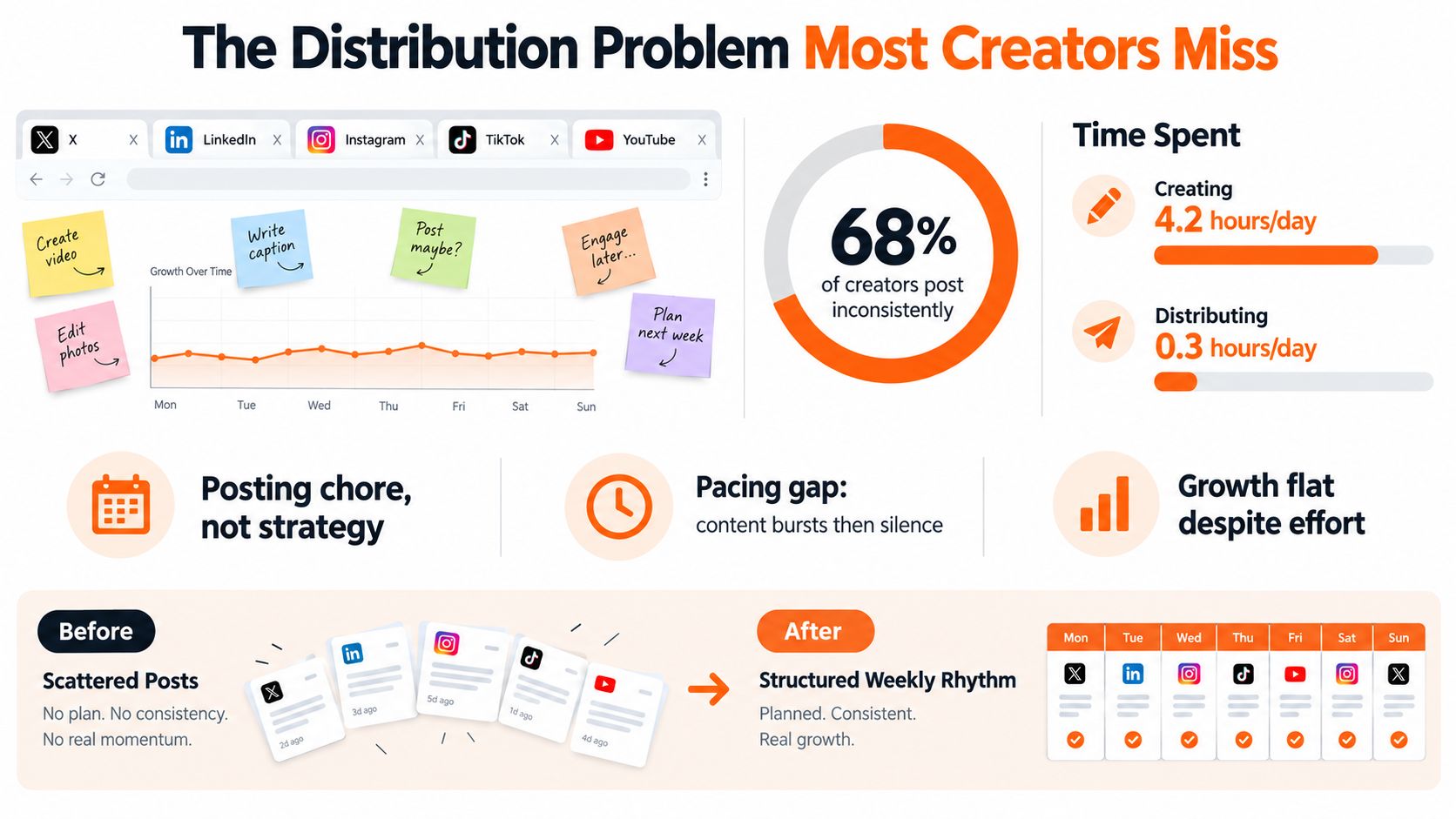
The hardest part of social media management is not writing. It's the constant context switching between platforms that all want a different shape, length, tone, and pace. DataReportal's global analysis makes the scale obvious, with approximately 5.79 billion social-media user identities worldwide in April 2026 and an average of 6.5 platforms per month for the typical user, which means your audience isn't sitting in one place waiting for one perfect post DataReportal social media users.
I used to publish like each network was a separate room. The result was predictable, a lot of effort, lots of tabs, and barely any movement on the outcome that mattered. When your workflow treats posting as the job, you end up optimizing for activity instead of distribution.
What changed when I started thinking like a distributor
The fix was simpler than the grind I'd built around it. I stopped making every post from scratch and started building one strong core idea, then adapting it into platform-specific versions that respected each channel's mechanics. That sounds obvious now, but it took me weeks to admit that the work was distribution, not creation.
Practical rule: one durable idea can power a week of social output if the thesis stays the same and the execution changes per platform.
That's why a good starting point is a distribution framework, not a content calendar full of disconnected prompts. If you want a deeper breakdown of that mindset, this explanation of content distribution is the right companion read.
You also don't need to guess how other teams think about this. Exerta's agency social playbook is useful because it shows how social work gets easier when the system is repeatable instead of improvised, especially for teams that need to move across channels without losing consistency. Exerta's agency social playbook
The point is simple. Social media management isn't a publishing habit, it's a cross-platform attention system. Once you see that, the goal changes from “keep the feed alive” to “move attention toward owned audience growth.”
Set One Outcome and Reverse-Engineer Your Platforms
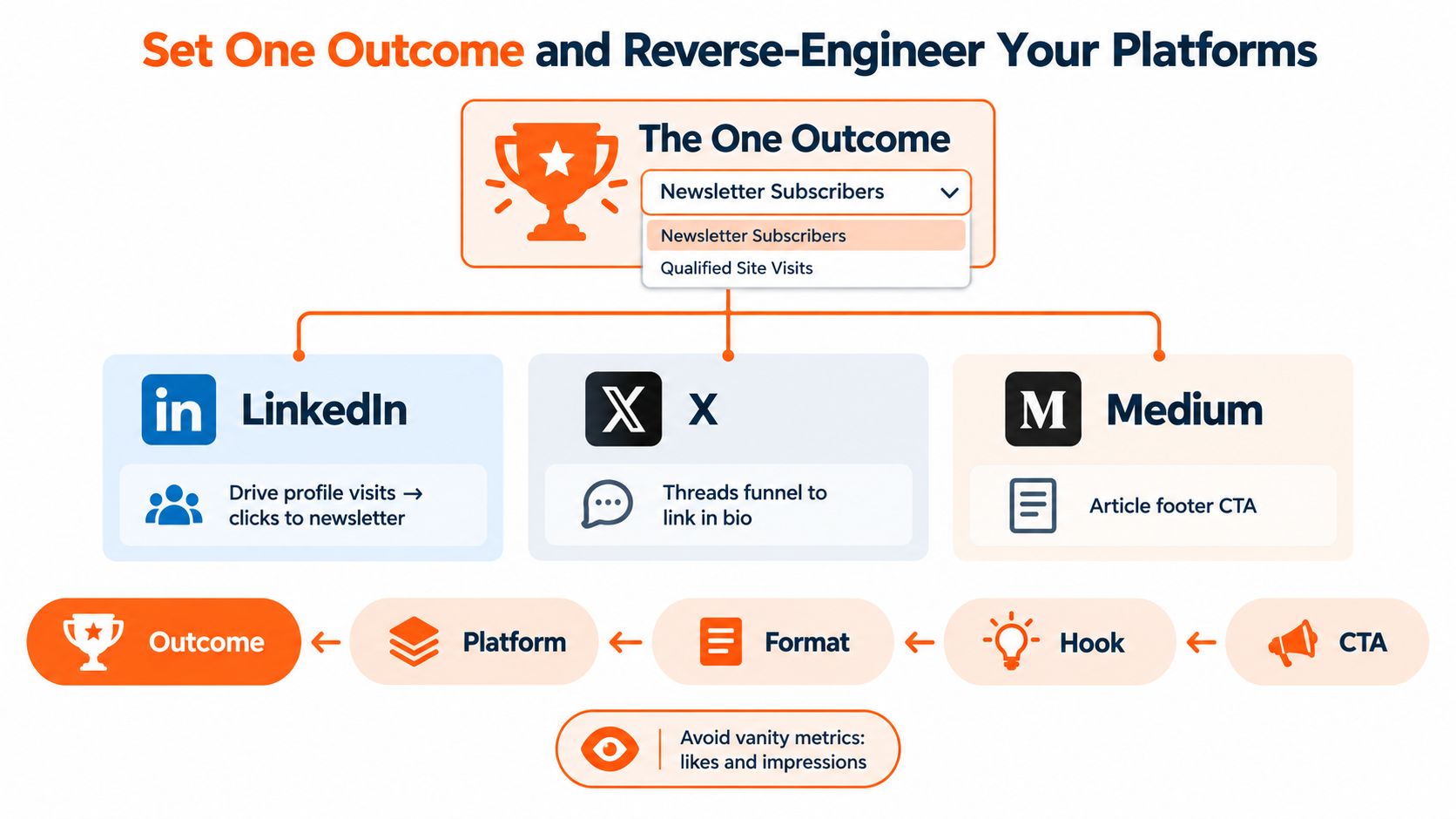
I got better results when I picked one business outcome and refused to blur it. For a writer, that's usually newsletter subscribers or qualified site visits. Everything else becomes support work, not the destination.
Pick the outcome before you touch a platform
This removes a lot of fake decisions. If the outcome is subscriptions, then each network needs a role in that journey, not the same job everywhere. LinkedIn might be about profile visits and newsletter clicks, X might be about thread discovery and link-in-bio traffic, and Medium might exist to capture search-style attention with a clean footer CTA.
The measurement part matters because gut feel lies. A defensible engagement-rate formula is total measurable interactions divided by follower count, but each platform has to document what counts as an interaction. On Facebook that can mean likes, comments, and shares. On Instagram, likes and comments. On X, likes and reposts. On TikTok, likes, comments, shares, and saves.
Measure the right thing for the right channel
A useful rhythm is to define the primary outcome first, then assign leading indicators to each platform. That keeps you from celebrating the wrong win. A post that gets light applause but no clicks might look good in the feed and still fail the business goal.
Use this simple logic:
- Primary outcome: one owned-audience goal, such as newsletter growth or qualified visits
- Platform indicator: the action that predicts that outcome, such as profile visits or link clicks
- Engagement rule: count only the interactions you've explicitly defined
- Review standard: compare each post with a baseline, not with one outlier
The comparison point matters too. Benchmark reports can be helpful, but they're only directional because audience size, paid distribution, and content mix all change the picture. Treat them like a map, not a promise.
The best-performing post isn't always the one with the loudest reaction. Sometimes it's the one that sends a smaller but cleaner flow into your owned channel.
Repurpose One Idea Into Platform-Specific Posts
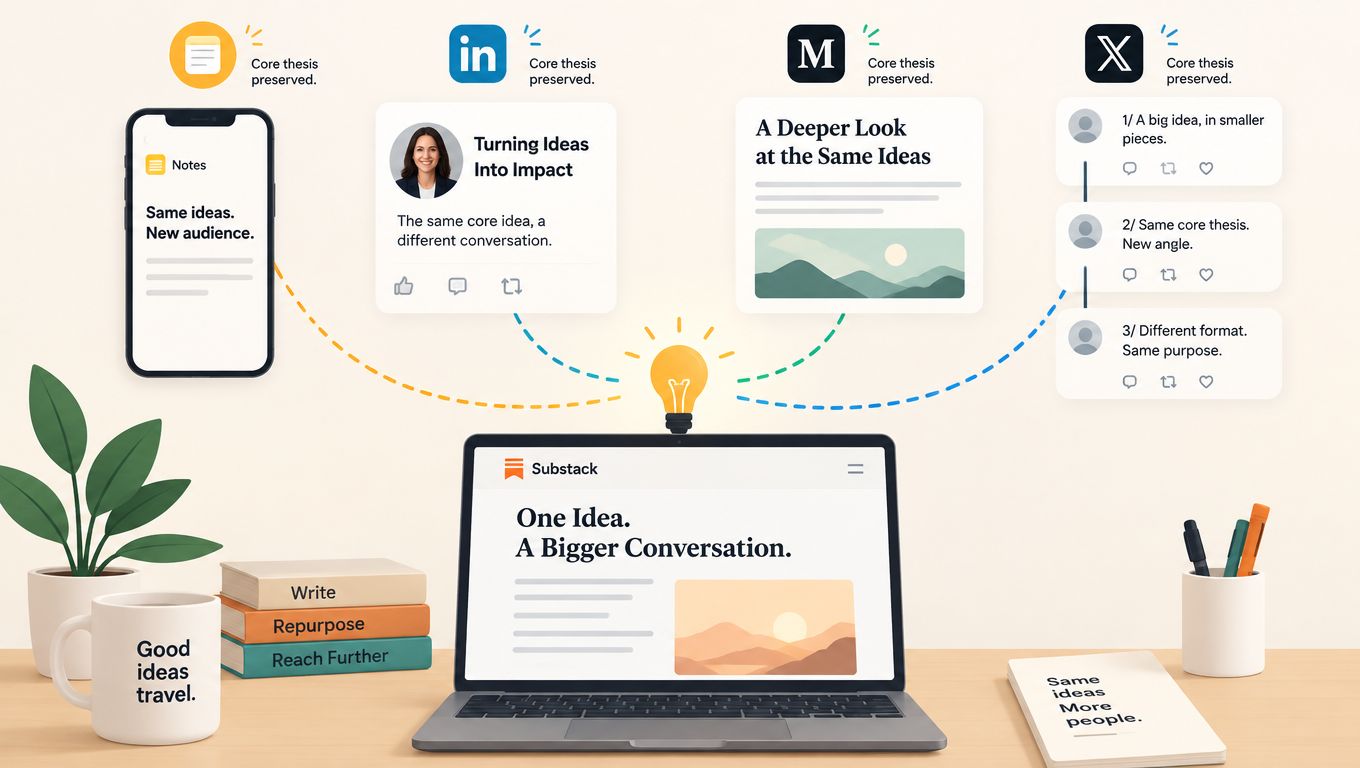
The first time I repurposed a Substack essay into LinkedIn, X, Medium, and Notes without starting over, I saved a ridiculous amount of energy. The key wasn't copying and pasting. It was keeping the thesis and evidence intact while rewriting the hook, structure, and call to action for each platform.
Substack now lets you schedule Notes natively on web, iOS, and Android, which makes batching much easier. On web, you create a Note, tap the calendar icon, choose a time in your local zone, and save it. On mobile, it's the three-dot menu and “Schedule,” and the scheduled post stays in Drafts until publication Substack Notes scheduling update.
What to keep and what to rewrite
Keep the central thesis, the strongest proof, and the point of view. Rewrite the opening so it fits the platform's attention pattern, then adjust the length and format so it feels native. A LinkedIn post can be more structured, an X thread can be tighter and more segmented, and a Medium version can lean into clarity and depth.
That's also where good tooling helps. If you want a practical view on adapting one idea across formats, these AI-powered content marketing tips are useful because they focus on custom output rather than generic automation.
I like to think of it as one core asset plus several derivatives:
- Substack article: the primary argument and full evidence
- LinkedIn post: the professional takeaway and a sharper opening
- X thread: the same idea broken into quick, readable beats
- Medium article: a polished long-form version with a different discovery angle
- Substack Notes: short reminders, fragments, or the strongest line
The whole point is to avoid rebuilding the same thought five times. If you're already writing on Substack, a repurposing workflow turns that writing into a distribution engine instead of a one-off publication.
Useful constraint: if a derivative post doesn't change the format, it probably isn't adapted enough.
Later, when the article is drafted, I'll queue the Notes, the LinkedIn version, and the X thread in one pass. That's where scheduling stops being a convenience and starts becoming a real systems advantage. If you're looking for more examples of that workflow, these content repurposing examples show how to keep the original idea intact while changing the delivery.
The part many skip is that repurposing isn't just for speed. It's for consistency, which is what lets a good idea keep working after the first post is gone.
Run a Measurement-First Content Ledger
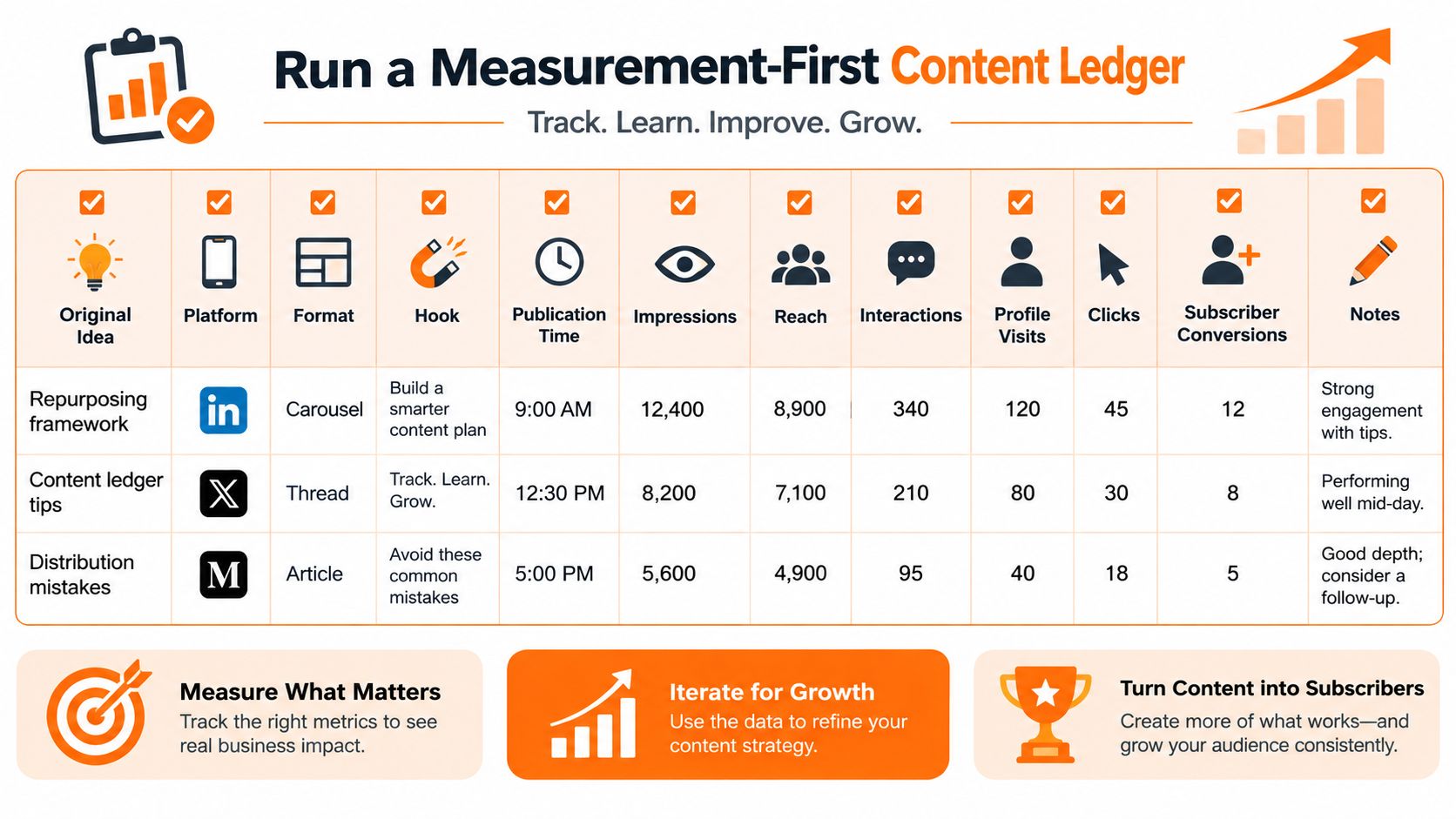
A weekly content ledger changed how I reviewed social performance. Instead of scrolling feeds and guessing what felt strong, I had one place where each post got judged against the same fields, the same baseline, and the same business goal. The table doesn't need to be fancy, but it does need to be complete.
What belongs in the ledger
Track the original idea, platform, format, hook, publication time, impressions, reach, interactions, profile visits, clicks, and subscriber conversions. Then add notes on what you'd repeat or change next time. That gives you a record of both the content and the decision-making around it.
A weekly ledger also helps you compare one post against the median of a relevant 30-day or 90-day baseline instead of overreacting to one viral spike. That's important because one outlier can trick you into repeating a format that only worked once.
Here's the habit I use:
- Log the post details: idea, platform, format, hook, and publish time
- Capture the numbers: impressions, reach, interactions, profile visits, clicks, and conversions
- Judge against the median: not the best day you ever had
- Note the learning: what changed the result
The best review session happens on the same day every week. Friday works well because it's close enough to the week's output to feel relevant, but far enough from the posting moment that the emotional reaction has cooled down.
For a broader dashboard view, this content analytics dashboard guide pairs nicely with a ledger because it turns raw activity into a clearer trend line.
How to spot winners without fooling yourself
Winners are posts that create movement toward the owned goal. That can mean clicks, profile visits, or subscriber conversions, not just likes. Once a post proves it can do that, I'll repurpose it again with a different hook, a different opening line, or a different format.
Practical rule: if a post gets applause but no downstream action, it's content noise, not a growth asset.
A measurement-first ledger also makes underperformers easier to kill. If a format repeatedly misses the median on both engagement and conversion, I stop feeding it production time. That discipline is boring, but it's how the workload gets lighter.
Add the Response Layer Most Calendars Skip
Publishing is only half the job. The other half is answering, routing, and resolving what happens after the post goes live. I learned that the hard way when comments sat unanswered long enough to turn into lost trust.
Build a response cadence, not a hope
Check comments, mentions, tags, and direct messages at least twice during active audience hours. Classify each interaction as praise, question, objection, support issue, or escalation, then route anything sensitive into private handling without abandoning the public thread.
The service standard should be specific. For high-intent questions, aim to reply within one hour. For everything else actionable, keep the target within 24 hours. The point isn't perfection, it's reliability.
The data behind that expectation is strong enough to matter. In one 2025 survey of 4,044 consumers who followed at least five brands, 73% said they'd buy from a competitor if a brand didn't respond on social media, and 81% said social media drove impulse purchases Sprout Social consumer survey. Another benchmark found that 52% expected a response within one hour, including 10% within five minutes, 22% within 30 minutes, and 20% within an hour social response benchmark.
Use automation without letting it speak for you
Automation helps with tagging, scheduling, dashboards, and first-draft repurposing. It should not make judgment calls on factual claims, complaints, or tone. That still needs a person, because a fast wrong answer is worse than a slightly slower accurate one.
I've found the cleanest setup is simple:
- Monitor actively: check the inbox twice during audience hours
- Triage quickly: sort by intent and urgency
- Reply with ownership: don't let questions bounce between people
- Escalate privately: move sensitive issues out of the public thread
- Review weekly: look for unresolved-message patterns and recurring objections
If you're using scheduling infrastructure, this social media scheduling template is a good fit because it keeps publishing rhythm and reply rhythm in the same operating frame. That matters more than another slot on the calendar.
A Weekly Rhythm for Solo Creators and Small Teams
The workflow finally felt manageable when I stopped trying to do everything every day. A weekly rhythm works better for solo creators and small teams because it separates thinking time, production time, distribution time, and response time. That separation removes the constant pressure to be “on” all day.
A cadence that actually fits real work
I batch the heavy lift first. One day goes to drafting the core asset, usually the article or newsletter. Another day goes to repurposing that asset into LinkedIn, X, Medium, and Substack Notes, then scheduling the pieces so they land across the week instead of in one burst.
That's where scheduling tools change the math. A reported comparison found that scheduling-tool users saved an average of 6.3 hours per week, or roughly 328 hours per year, and that 91% of marketers using scheduling tools saw improved posting consistency scheduling tool usage study. I don't treat those numbers as a promise for every workflow, but they do explain why batching feels less like a luxury and more like the only sane way to stay consistent.
Here's a rhythm that holds up:
- Monday: draft the main article or newsletter
- Tuesday: repurpose into short-form posts and Notes
- Wednesday: schedule the week's distribution
- Daily: two monitoring windows for comments and DMs
- Friday: review the content ledger and decide what gets another pass
Why this rhythm reduces burnout
The biggest win is not speed, it's fewer decisions. When every task has a day and a purpose, you stop reopening the same files ten times. You also stop wasting creative energy on whether to post now, later, or somewhere else.
For teams that want a practical planning reference, this sustainable growth strategy resource pairs well with a rhythm like this because it keeps growth tied to repeatable behavior instead of random bursts of effort.
A small team can run the same model with fewer moving parts. One person writes, one person checks response coverage, and one weekly review decides what gets promoted again. A solo creator can do it all inside one notebook, one scheduler, and one ledger.
The rhythm should make the work quieter, not busier.
When the system is working, social stops feeling like a daily emergency and starts behaving like a distribution machine for owned audience growth.
Stop Posting Everywhere and Start Building an Audience
The “post everywhere, all the time” myth burns people out because it confuses motion with progress. You can stay visibly active and still fail to build an audience that belongs to you. The smarter move is to use each network as part of one distribution system that feeds newsletter growth, site visits, or qualified reader action.
The contrarian truth is still the useful one, the best social post isn't always the one with the most likes. It's often the one that creates a small but measurable flow into an owned channel. That's the difference between being busy online and building something durable.
If you want the simplest next move, choose one primary outcome, one weekly ledger, and one repurposing workflow, then run it for a month before changing it. If you just want the operating principles, keep the framework and adapt it to your own stack. If you want a system that handles scheduling, cross-platform publishing, and tracking in one place, Narrareach is built for writers and creators who want to move a core idea into Substack Notes, LinkedIn, Medium, and X without copy-paste drift.
Narrareach helps you turn one strong piece into scheduled distribution across Substack, LinkedIn, Medium, and X, while keeping the work tied to subscriber growth instead of vanity metrics. If you're ready to consolidate your publishing and measurement into one workflow, visit Narrareach and see how your next article can become a real distribution engine.