How Narrareach’s Substack Scheduling Handoff Works
See how Narrareach creates eligible scheduled items inside Substack, records confirmation, handles retries, and reconciles publication.
The Narrareach Substack handoff creates an eligible Note or compatible article inside Substack before it is due. When Substack confirms that remote schedule, Substack—not an open Narrareach browser tab—owns the final publication event. Narrareach keeps the local queue, remote identifier, reconciliation, retry, cleanup, and review-needed state around that handoff.
Why the handoff exists
Narrareach uses the selected writer’s authenticated Substack context and Substack’s scheduling interface to create compatible future items. Substack does not document this as a conventional public third-party publishing API, so the durable evidence is the destination handoff: the item exists inside Substack with a remote identifier and confirmed time. Substack’s first-party documentation confirms native future scheduling for both Notes and articles.
For direct verification, Substack says scheduled Notes are saved to Drafts and scheduled articles can currently be set up to three months ahead. Article publication follows the writer’s device timezone.
“Scheduled” is therefore not one state. A draft can be saved locally, waiting to be handed off, confirmed inside Substack, published, or blocked for review.
The scheduling sequence
1. Narrareach prepares the item
The writer selects the Substack publication, content, media, and future time. Narrareach validates the format and account state before attempting a remote schedule.
2. A healthy connection creates the remote schedule
Narrareach uses the selected writer’s authenticated Substack context to create the future item. The connection must be healthy at this point. An item that is only in the local queue should not be described as safely scheduled on Substack.
3. Narrareach records Substack’s identifier
After confirmation, Narrareach stores the remote draft identifier and schedule state. This is the evidence that the handoff succeeded and the basis for later reconciliation, edits, cancellation, or cleanup.
4. Substack publishes at the slot
For a confirmed eligible Note or compatible article, the browser does not need to remain open. Substack owns the final timer and publication event.
5. Narrareach reconciles the outcome
Narrareach compares local queue state with the remote item and records success, retryable failure, or a state that needs review. This prevents a local calendar from silently claiming success when the destination disagrees.
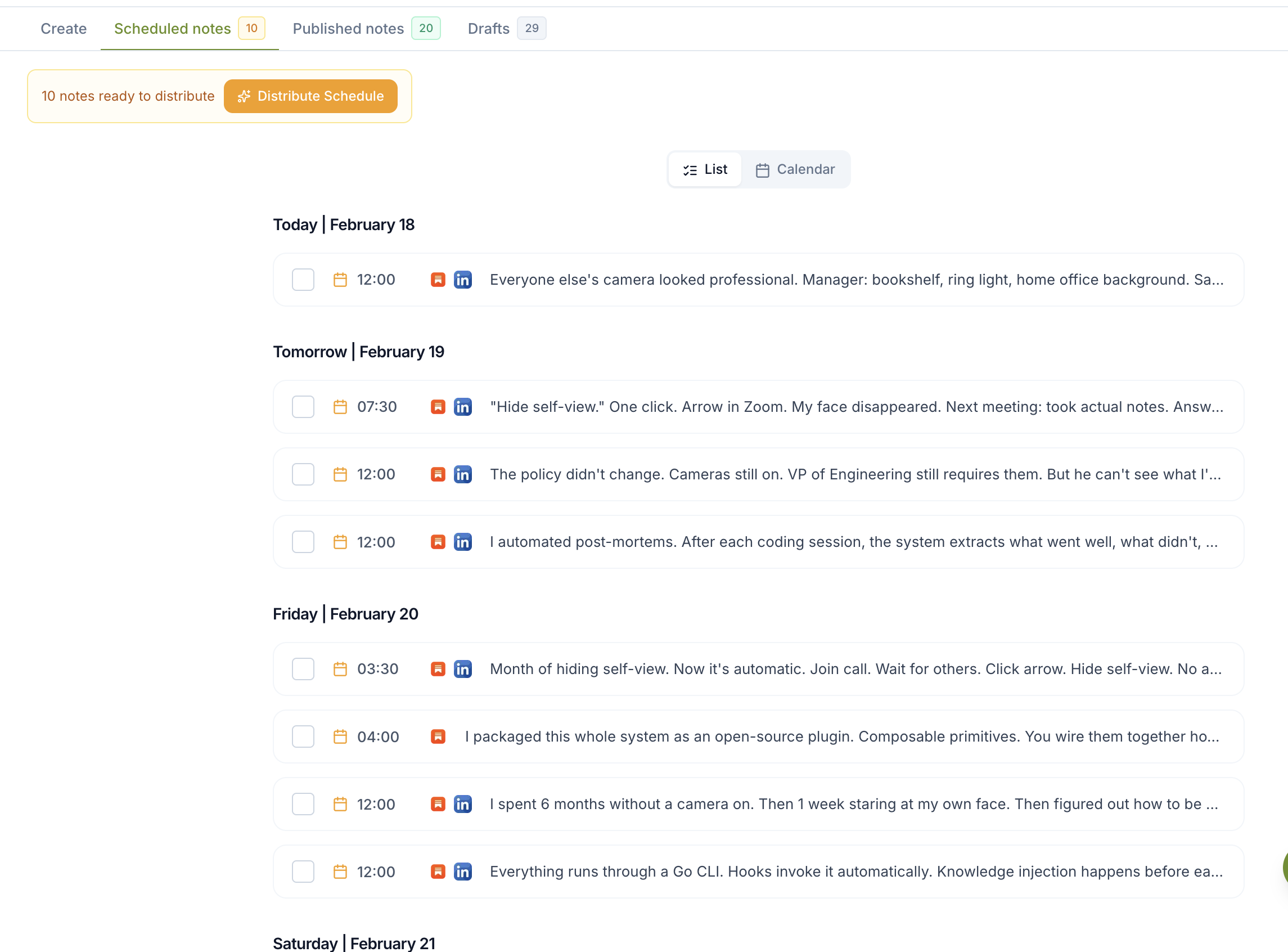
The Narrareach queue groups upcoming Notes by date and destination. A queue entry represents publishing intent; the remote confirmation state is what establishes that Substack accepted the handoff.
What the handoff can prove
The handoff provides operational evidence, not a promise that every future post will succeed. Narrareach can record that it attempted the remote create, which Substack draft identifier came back, which time was confirmed, and whether later reconciliation still finds the expected item. Those fields let the product distinguish five materially different states: prepared locally, waiting for handoff, confirmed remotely, published, and blocked for review.
That distinction prevents two common errors. First, a green local calendar entry cannot silently stand in for destination acceptance. Second, a retry can use the recorded remote identifier instead of blindly creating another future item. When the schedule is confirmed, the writer can close the browser because Substack owns the timer. When it is not confirmed, Narrareach should show recovery work rather than imply that publication is safe.
This evidence is also useful for support. A writer can check the intended publication and time in Narrareach, find the item in Substack’s Drafts or scheduled view, and compare the two before creating a manual replacement.
What happens when something changes
Edits and cancellations need access to the selected Substack publication. If the connection has expired, Narrareach can surface a reconnect or review-needed state rather than treating the change as complete. Retry logic is bounded and the remote identifier prevents a retry from blindly creating a second item.
The exact path can differ for media, reply threads, restacks, and other rich Note formats. Confirm the state shown for the item you scheduled; do not infer that every Substack format follows the text-Note path.
Where the reliable handoff stops
A reliable handoff does not remove every dependency. Narrareach still needs a healthy authenticated connection when it creates the item, changes its schedule, edits it, or cancels it. Compatibility also depends on the content format. Text Notes and compatible articles can follow the confirmed remote path, while media-heavy Notes, reply threads, restacks, or newly introduced Substack formats may require a different route or human review.
The safe product language is therefore specific: once an eligible item is confirmed inside Substack, the browser does not need to remain open for the final timer. It would be inaccurate to say every Substack format always uses the same path or that reconnecting is never necessary.
How this differs from native Substack scheduling
Substack’s own Notes scheduler is the simplest route for one Note. Narrareach adds batch preparation, a shared calendar with other supported destinations, platform-specific adaptations, recovery state, and the available evidence after publication.
Native scheduling is still the right choice when you publish occasionally and only on Substack. Narrareach becomes useful when the Note belongs to a larger article and distribution workflow.
How to verify a scheduled item
Check the Narrareach state, then verify that the item appears in Substack’s scheduled or draft view with the intended publication, content, timezone, and date. After publication, verify the destination URL before treating the workflow as complete.
For the broader workflow, see Narrareach’s Substack automation guide. The important operational rule is simple: a local queue means Narrareach intends to schedule; a confirmed remote item means Substack accepted the handoff.
Writers comparing that workflow with a broader social research product can also read Narrareach vs Eden. The comparison uses the same destination-level test: create a real item, confirm it inside Substack, change it, interrupt the connection, and inspect the recovery state.
If the two systems disagree, trust the destination for whether a Substack item exists and use Narrareach’s recovery state to repair the workflow. Do not create a second manual schedule until you have checked the remote identifier and scheduled drafts; otherwise a delayed retry and the manual copy can both publish. This is why confirmation and idempotent retry behavior matter more than a reassuring calendar color.