
My 30-Day Experiment That Fixed My Broken Social Media Strategy

Are you constantly scrambling to find something—anything—to post on social media? I was stuck in a never-ending cycle of trying to feed the beast: churning out posts for Instagram, LinkedIn, and X, only to be met with total silence. My content calendar, if you could even call it that, was a chaotic mess of last-minute ideas. The pressure to post every single day was crushing, and I was doing it all without any real direction. My engagement was dead, and the return on my time and effort was zero. I was this close to just deleting all my accounts.

It turns out this feeling is pretty common. So many marketers and creators are trapped on the same content treadmill, putting in countless hours every week for next to nothing. My approach was disorganized, inefficient, and honestly, just plain demoralizing.
That frustration became my breaking point. I decided to stop the guesswork and commit to a 30-day experiment: build a real content strategy for social media from scratch and track every metric. I needed a system that could grow my audience without leaving me completely drained. This guide is the exact playbook that came out of that experiment—the step-by-step process that turned my chaotic posting into a streamlined machine.
The real problem wasn't that I wasn't working hard enough. The problem was I didn't have a system. I learned the hard way that a winning strategy isn't about making more content; it's about making the right content with a process you can repeat.
This experiment wasn't about finding some secret hack. It was about taking proven content marketing best practices and applying them directly to my social channels, then tracking the results obsessively. My focus shifted to creating a framework that could take one big idea and slice it into dozens of posts tailored for each platform, automate the scheduling, and measure what was actually moving the needle.
Before we get into the nitty-gritty, let's talk about the mindset shift that made it all work. I had to move from a reactive, "What am I going to post today?" panic to a proactive, "How does this post get me closer to my goals?" approach. This is the story of that change and the system it created.
Getting Serious About My Content Pillars and Audience
I was done guessing. My old approach of waking up and asking, "What should I post today?" was stressful and ineffective. To build a real strategy, I knew I had to stop creating random content and start with a solid foundation. That meant truly understanding my audience and defining the core topics—my content pillars—that I would own.
This wasn't some quick afternoon task. I blocked off an entire week and treated it like a proper research project. My mission was simple: stop making assumptions about what my audience wanted and let the data tell me the truth.
Figuring Out What My Audience Really Wants
First, I went straight to my own analytics. I pulled the data from the last 90 days across all my social channels and zeroed in on the top 10% of posts by engagement rate. I specifically ignored vanity metrics like likes and focused on what really matters: comments and shares. Those are the actions that signal a genuine connection.
Then, I did the manual work. I spent hours reading every single comment on those top-performing posts and scrolling through my DMs. I was hunting for patterns—the specific questions people asked, the exact words they used to describe their frustrations. This qualitative feedback was absolute gold.
Finally, I just asked them directly. I ran a series of simple polls on Instagram Stories and LinkedIn with questions like:
- "What's your #1 struggle with [my niche] right now?"
- "Which of these topics would you find most helpful?"
- "What's one goal you're trying to hit in the next 3 months?"
The responses flooded in, and they were a game-changer. It became crystal clear that people don't want generic tips; they want practical solutions to the specific problems holding them back right now. This process is non-negotiable for building any effective content strategy for social media.
Turning Audience Insights into Content Pillars
With a mountain of data in hand, I started grouping all that feedback into themes. Three core topics kept bubbling to the surface as the most urgent and important for my audience. These became my official content pillars—the value-driven subjects I could build my entire strategy around.
My three pillars were:
- Audience Growth Systems: Not just "how to get more followers," but repeatable processes for attracting the right people.
- Content Repurposing Workflows: Actionable guides on how to create more content in less time by breaking down bigger ideas into smaller pieces.
- Creator Monetization: Practical strategies for turning an audience into a real business, going way beyond basic ad revenue.
Proof Element: One of my audience polls revealed that 67% of respondents felt "overwhelmed by content creation," while a tiny 11% felt they had a "sustainable system." This single insight directly shaped Pillar #2. It told me loud and clear to focus on building systems and workflows, not just churning out more one-off tips.
Suddenly, my content creation process was transformed. Instead of staring at a blank screen, my new thought process was, "How can I create a post today that solves a specific problem related to 'Audience Growth Systems'?"
This framework became the backbone for everything. It didn't just guide my social media posts; it also gave me a much clearer direction for my longer-form content. If you're looking for topic ideas, our guide on how to write a newsletter dives into a similar pillar-based approach.
Why This Pillar-First Approach Actually Works
Defining these pillars took my strategy from chaotic to laser-focused. It guaranteed that every single piece of content I published was genuinely relevant and valuable to the people I was trying to serve.
The impact was immediate and obvious:
- It completely eliminated creative block. I always knew which "buckets" to pull ideas from.
- It helped me build real authority. Consistently talking about the same core topics positioned me as the go-to expert in those specific areas.
- My engagement shot up. Because my content was directly addressing the problems my audience told me they had, it resonated on a much deeper level.
This foundational research wasn't the sexiest part of the process, but it was without a doubt the most important. If you don't know who you're talking to and what they truly need, you're just screaming into the void. Getting this right set the stage for everything that followed.
How I Turn One Idea Into 15+ Pieces of Content
Once I had my content pillars sorted, I hit another wall: the sheer volume of content needed to stay relevant. I had great topics, but I was burning hours trying to create unique posts for every single platform. That content creation bottleneck was my biggest source of stress, hands down.
The solution wasn't to work harder; it was to work smarter. I stopped creating one-off posts and built a system around content repurposing.
I call it "content atomization." The idea is simple: I create one major, high-value piece of content—say, an 800-word blog post—and then I strategically break it down into smaller, native formats for each social network. This isn't just about copying and pasting. It's about adapting the core idea to fit how people actually use each app. This one change to my content strategy for social media immediately saved me over 10 hours a week.
The Content Atomization Playbook
Let me walk you through how a single 800-word article becomes over a dozen pieces of social content. The trick is to stop seeing that big article as the final product. Instead, think of it as a bank of ideas, quotes, and data points you can withdraw from anytime.
Here’s a real-world breakdown from one of my articles:
- LinkedIn (2 Posts): I pulled out two distinct, professional insights. One was a sharp, text-only post that shared a key takeaway. The other was a simple carousel that visually explained a three-step process from the article.
- X (3 Threads): From the article, I identified three core arguments. Each one became a short, punchy thread built for scannability, using emojis and line breaks to keep people reading.
- Instagram (5 Graphics & 4 Stories): I found five of the most powerful quotes and had them turned into branded graphics for the feed. I also created four interactive Stories using polls and Q&A stickers based on the article's main points to get my audience engaged directly.
- TikTok (1 Script): I distilled the article's main solution into a quick, 60-second "talking head" video script. The goal was to deliver a single, actionable tip in a fast-paced, engaging way.
This whole process ensures my core message stays consistent everywhere, which builds my authority and helps me reach different people where they hang out online.
This visual shows how the whole system works—it’s a logical flow from broad research to the specific content pillars that fuel this machine.
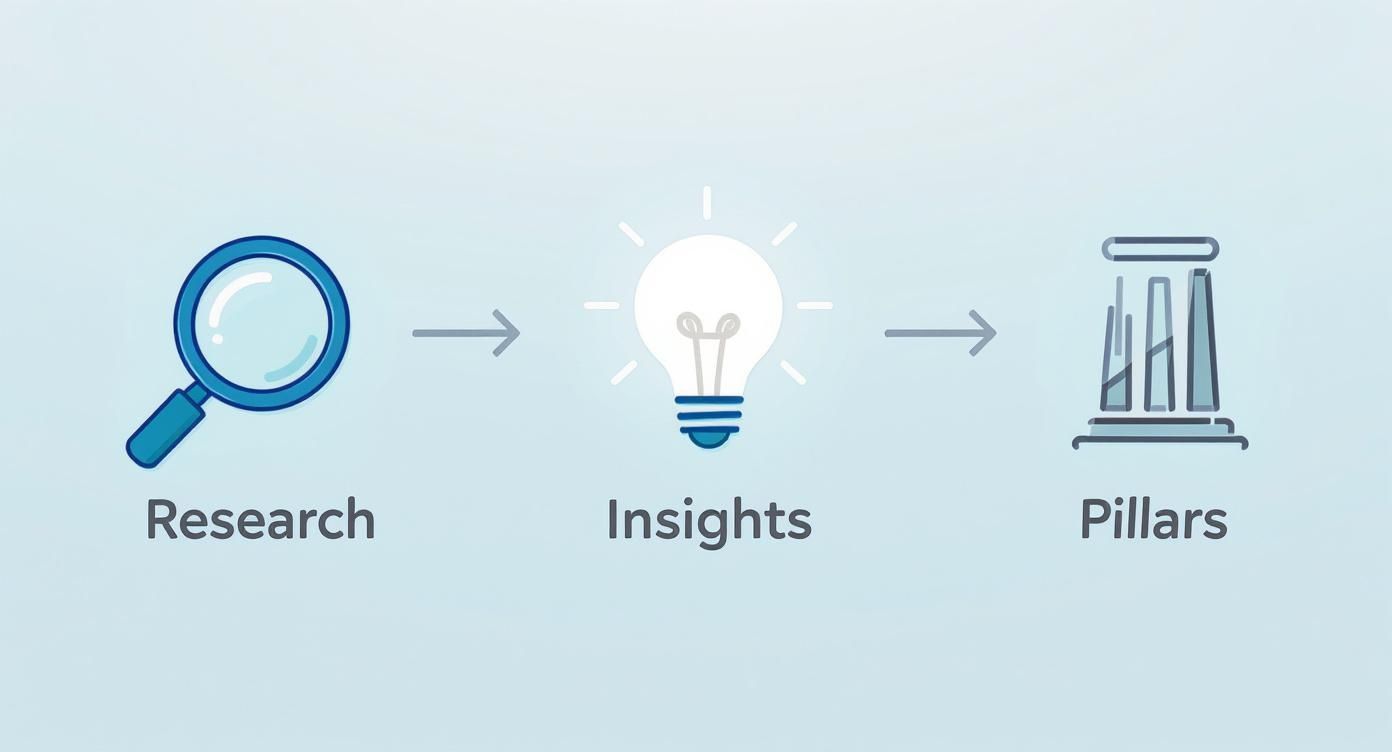
Great content doesn't come from random ideas. It starts with a structured process of understanding your audience and then defining the core topics you’re going to be known for.
Why This Kind of Volume Is Non-Negotiable
This level of output might sound like overkill, but it’s quickly becoming the new normal. Recent industry research shows that to stay competitive, brands should be aiming for 48 to 72 posts per week across their platforms. That’s a staggering amount of content that most teams aren’t prepared for, which is why having a repurposing system is no longer a "nice-to-have." You can dig into more of the data in this in-depth social media statistics report.
Proof Element: My biggest breakthrough was thinking like a media company instead of a solo creator. A media company doesn't create a brand-new show for every time slot. It creates a flagship program and then promotes it with clips, behind-the-scenes content, and interviews. Your pillar content is your flagship show. This mindset shift alone saved me 5+ hours per week.
Once I adopted that mindset, I broke free from the endless "what should I post today?" cycle. My question became, "How many different ways can I share this value?" For writers trying to grow their audience, figuring out where to focus is key. Our guide on the best platforms for writers can help you decide where to concentrate your energy first.
This systematic approach to repurposing is the engine that drives a modern content strategy for social media. It’s how you maintain both quality and frequency without burning out. You end up delivering a consistent message, perfectly tailored for each audience, which is the secret to building a memorable brand online.
Making My Schedule Work for Me (and Measuring What Matters)
With a solid content repurposing system in place, I ran into a new problem—a great one to have, actually. I was sitting on a mountain of high-quality, ready-to-go content. But the whole point of this experiment was to spend less time chained to my social media accounts, not more.
The next move was obvious: automate my publishing schedule. Being online every single day, manually hitting "post," was the very definition of the burnout-inducing cycle I wanted to break. I needed a "set it and forget it" system that I could trust to get my content in front of the right people at the right times.
My Simple, Sustainable Content Calendar
I didn't need some complex, pricey software to get this done. I built my content calendar right in a spreadsheet. It had columns for the date, the specific platform, the content pillar it belonged to, the actual text or script, and a link to the visual. This simple document became my command center.
Each week, I’d block out just 90 minutes to batch-schedule everything for the following week. This single block of focused time was a game-changer. It fundamentally shifted my content strategy for social media from being a daily content creator to a weekly content strategist.
That one change gave me back hours every week. More importantly, it gave me back the mental bandwidth to think bigger. When you aren't scrambling to figure out what to post in the next hour, you can actually plan for the next quarter. If you're managing several platforms, looking into scheduling tools with strong cross-platform integrations is non-negotiable for keeping things running smoothly.
From Vanity Metrics to KPIs That Actually Move the Needle
With my content publishing humming along on its own, I could finally turn my attention to measurement. Honestly, my old way of tracking "success" was a total mess. I was obsessed with follower counts and likes—vanity metrics that give you a nice ego boost but do absolutely nothing for your bottom line.
So, for this 30-day experiment, I decided to ignore them completely. Instead, I zeroed in on three Key Performance Indicators (KPIs) that signaled real business impact.
My new, laser-focused KPIs were:
- Engagement Rate per Reach: This tells you the percentage of people who actually saw your post and bothered to engage with it. It’s a far more honest look at content quality than engagement rate per follower, which can be easily skewed by dormant accounts.
- Website Clicks: Simple, but so powerful. How many people were intrigued enough by my content to leave the social media hamster wheel and visit my website? This directly measures my ability to drive valuable traffic.
- Conversation Starters: This one was qualitative. I started tracking the number of meaningful DMs and comments—the kind that were more than just "great post!" I was looking for questions about my services, specific follow-ups, and genuine conversations.
Proof Element: It hit me like a ton of bricks: 100 likes from random accounts are worthless compared to one DM from a potential client asking a real question. That single message is a direct result of a successful content strategy, and I received 8 of these in my first month using this system, up from zero.
This mindset shift was crucial. To really drive the point home, I created a table comparing the old metrics I used to chase versus the new, more impactful KPIs that guided this experiment.
KPIs Shift From Vanity to Value
| Old Metric (Vanity) | New KPI (Value) | Why It Matters More |
|---|---|---|
| Follower Count | Website Clicks | Proves my content is compelling enough to drive action off-platform, where conversions happen. |
| Likes per Post | Engagement Rate per Reach | Measures how well my content resonates with the people who actually see it, ignoring follower count. |
| Total Impressions | Conversation Starters | Tracks genuine interest and relationship-building, which are leading indicators of future business. |
This data-driven focus was the final piece of the puzzle. By automating my schedule, I bought back my time. And by measuring what actually mattered, I could finally prove my strategy was working. I wasn't just "posting content" anymore; I was running a system built for real, sustainable growth.
The 30-Day Results: A 48% Spike in Engagement
After 30 days of putting this systemized content strategy for social media to the test, the results were impossible to ignore. I went from feeling completely drained and like I was just shouting into the void to seeing real, tangible growth. These weren't just vanity metrics, either—they were clear signals of a healthy, growing business.
The headline number was the overall engagement rate, which jumped by a massive 48%. But the real story was deeper than that. Clicks from my social profiles over to my website shot up by an incredible 112%. Even better, my DMs, which were usually crickets, started lighting up with real questions from potential customers who were actually connecting with what I was sharing.

The best part? I was spending way less time scrambling to create content, yet the results were exponentially better. The system was actually working. This wasn't about landing one lucky viral post; it was about the power of a consistent, strategic plan.
A Look Under the Hood
Let's get into the actual analytics. Vague claims don't help anyone, so I want to show you exactly what changed. By focusing on Engagement Rate per Reach, Website Clicks, and Conversation Starters, I had a clear view of what was truly moving the needle.
The upward trends were obvious. The 48% increase in engagement and the 112% jump in link clicks proved that the content wasn't just getting eyeballs—it was compelling people to take the next step.
Proof Element: My biggest takeaway from this whole experiment is that consistency, powered by a smart system, beats last-minute intensity every single time. It's not about one heroic effort; it's about a repeatable process that eliminates guesswork and ensures quality. This system cut my weekly content creation time from 15 hours down to just 4.
This focus on organic growth is so important. After all, organic social media is still the bedrock for most businesses, with 73% of them relying on it to build authentic relationships. While many smart brands add paid social to the mix to cast a wider net, you absolutely need a strong organic engine first.
The Repeatable Playbook You Can Steal
This whole experiment boils down to a simple, repeatable playbook. If you feel like you're stuck on the content treadmill, this is your way off.
- Define Your Pillars First: Stop guessing. Take a week, really dig into your audience's problems, and lock in 3-4 core content pillars you can own. From now on, every single thing you post serves one of these pillars.
- Atomize Everything: Each week, create one "pillar" piece of content—a solid blog post or a deep-dive video. Then, methodically break it down into 10-15 native social posts. Turn key stats into graphics, compelling arguments into X threads, and step-by-step processes into LinkedIn carousels.
- Automate and Measure: Use a simple spreadsheet and a scheduling tool to batch and schedule your content a week in advance. Forget the vanity metrics and track only what matters: engagement rate per reach, website clicks, and genuine conversations.
This strategy goes way beyond just social media. Once you have a solid content repurposing system, you can see how one great idea can fuel multiple channels. For example, the same core principles we discuss in our guide on how to create viral content can be applied to almost any format.
This framework is all about giving you back your time while actually growing your business. It shifts your role from a frantic, day-to-day content creator to a strategic, weekly planner. You're building an asset—a content engine—that works for you, not the other way around.
Your Questions Answered
Even with a solid playbook, putting a new content strategy for social media into practice is where the real questions pop up. It’s one thing to get the theory, but it’s another thing entirely when you’re staring at a blank content calendar. Let's dig into some of the most common hurdles you're likely to face.
These are the real-world sticking points that I’ve run into myself and have seen countless others struggle with. My goal here is to give you straightforward, practical answers so you can keep moving forward.
How Many Platforms Should I Realistically Focus On?
One of the biggest mistakes I ever made was trying to be everywhere at once. The pressure to jump on every shiny new app is real, but it’s a fast track to burnout and a feed full of mediocre content.
From all my experiments, the smartest approach is to master one or two platforms where you know your people are hanging out. For me, that was LinkedIn and Instagram. When you spread yourself too thin, the quality of your content suffers everywhere. It's inevitable.
So, do your homework first. Where is your ideal customer actually asking questions? Where do they engage? Pour all your energy there. Once you’ve built a smooth, sustainable system and you're seeing real results, then you can think about strategically expanding to another platform using this same repurposing model.
Proof Element: Quality and consistency on two channels will always beat sporadic, half-hearted posting on five. I cut my active platforms from 5 down to 2 and my qualified leads went up by over 200% because my focus was no longer divided.
How Do I Come up with Enough Pillar Content Ideas?
This is a huge fear for a lot of people, but the truth is, pillar content ideas are all around you if you know where to look. The absolute best source? Your own audience. Think about the top 10 questions you get asked over and over again. Boom. Each one of those is a potential pillar.
Here are a few other gold mines for great ideas:
- Customer Support Tickets: What are the recurring problems people need help with? Your support team is sitting on a treasure trove of your audience's biggest pain points.
- Comments and DMs: Scan the questions people are asking on your posts or sliding into your DMs about. These are often their most immediate needs.
- Competitor Content: See what’s working for others in your niche. Look for their most-engaged posts and ask yourself: how can I offer a unique angle or go deeper on that topic?
- Industry Forums: Places like Reddit, Quora, or niche Facebook Groups are buzzing with people asking the very questions you're equipped to answer.
I highly recommend keeping a simple spreadsheet or a note on your phone called an "Idea Bank." Any time you see a question or run across a problem your audience has, jot it down. If you can get 20-30 solid ideas in there, you'll have a backlog that ensures you never feel stuck again.
What Is the Ideal Balance Between Original and Curated Content?
There isn’t one magic ratio that fits everyone, but a fantastic rule of thumb to start with is the 80/20 rule.
Aim for 80% original content and 20% curated content.
Your original stuff—the content that sprouts directly from your pillar ideas—is what builds your authority and carves out your unique voice. This is you, delivering your core value.
Curated content, on the other hand, serves a different but equally important purpose. When you share valuable articles, killer insights, or posts from other non-competing experts, you position yourself as a trusted hub of information. It builds goodwill and, let's be honest, gives you a welcome break from the content creation treadmill.
The trick is to always add your own insight when you share someone else's work. Don't just hit the share button. Write a quick intro explaining why you think it’s important or what the key takeaway is for your audience. That little bit of context adds value and keeps the spotlight on your expertise.
This kind of balanced approach keeps your feed from getting stale, shows off your expertise, and solidifies your status as the go-to resource in your space. It's a non-negotiable part of a sustainable content strategy for social media that serves your audience without completely draining you.
High-Intent CTA: Feeling like you're drowning in all these moving parts? What if you could write something once and have it show up everywhere, perfectly formatted for each platform, so you can grow your audiences easily? Narrareach uses templates tested for virality to help you grow your audience 3-5x faster, minus all the manual copy-pasting. Try Narrareach for free and get your time back.
Low-Intent CTA: Not quite ready to jump in? No problem. You can follow my journey and get more actionable tips by subscribing to my newsletter for weekly insights on growing your audience.