My Substack Grew 315% After I Ran This 30-Day Content Distribution Experiment
You spend 10 hours polishing a brilliant article. You hit “publish” on Substack, feeling a rush of accomplishment. Then, reality hits. Now you have to copy it, paste it into LinkedIn, fix the busted formatting, re-upload all the images, and then maybe… just maybe… you’ll remember to chop it up into a few Substack Notes later in the week. By the end, you’ve wasted 90 minutes on mind-numbing logistics and feel more like an admin than a creator. Your motivation is shot, and your next great idea is already collecting dust. Sound familiar? That was my life.
My Content Workflow Was a Time-Sucking Mess
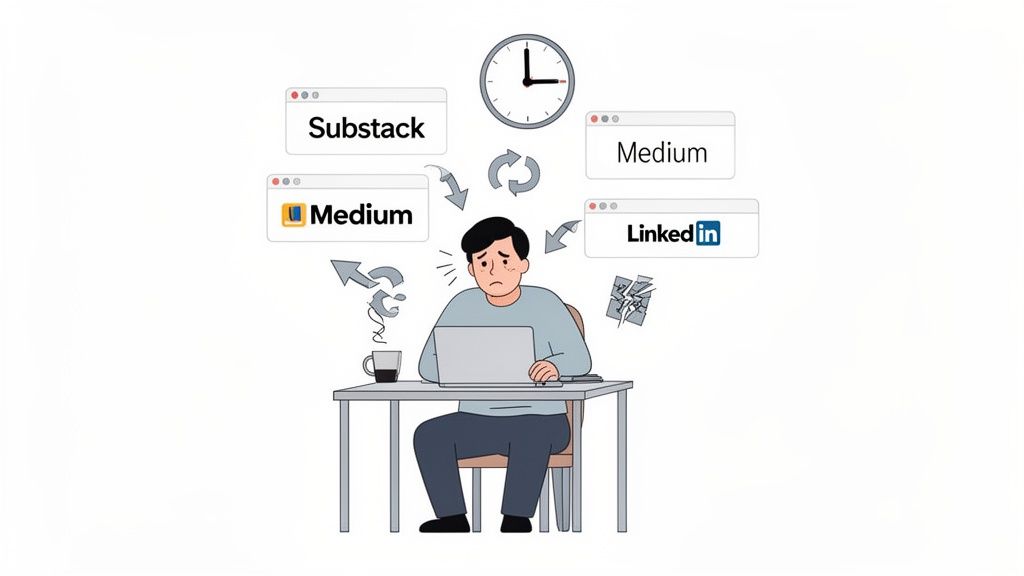
I’d fight with broken formatting, re-upload images that didn't transfer right, and triple-check that the paywalls were set correctly on each platform. This constant, low-value work was the biggest bottleneck to my growth.
I was slamming into what I call the "Content Amplification Ceiling"—that infuriating point where the time it takes to distribute your work steals the time you need to create your next piece. It felt like I was spending more energy on logistics than on actual writing. I remember missing a perfect 9 AM posting window on LinkedIn because a header image for Substack wouldn't resize. This one small failure represented a huge problem: my manual system was unsustainable and actively holding me back from growing my audience.
The Real Cost of Manual Distribution
The true cost wasn't just the lost time; it was the lost opportunity. Every minute spent copy-pasting was a minute I wasn't spending engaging with readers, brainstorming new ideas, or analyzing what actually worked. This manual grind is what keeps serious creators from scaling their audience and their impact. For proof, just look at my calendar from before this experiment: I was logging an average of 6 hours per month just on the manual task of moving content between platforms.
It's a classic trap for creators: you get so bogged down in the mechanics of publishing that you forget your primary job is to create and connect.
The process of manually juggling multiple platforms can feel completely overwhelming. If you want to dive deeper into this specific challenge, our guide on how to manage multiple social media accounts is a great place to start. This whole introduction is for every writer out there who feels more like a manual publisher than a creator.
What Is a Content Distribution Tool?
After hitting my breaking point with manual posting, I decided to look for a solution. A content distribution tool is essentially a central command center for your writing. It’s the simple but powerful idea of “write once, publish everywhere,” finally brought to life. It lets you grow your audience faster by turning distribution into an efficient, automated system instead of a manual chore.
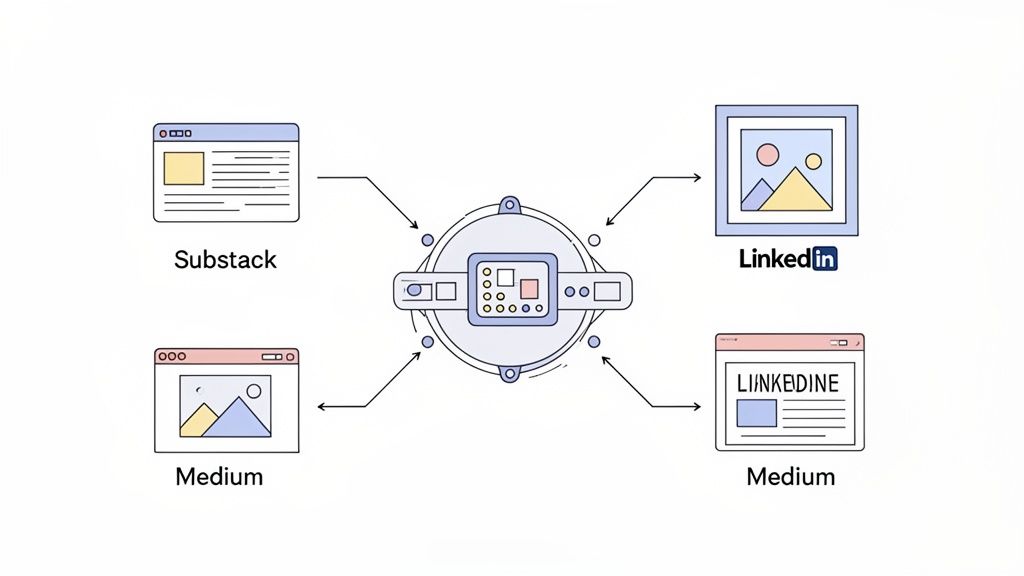
Think of it as a smart shipping service for your ideas. You write your article or Substack Note a single time in one place. Then, the tool intelligently delivers it to all your chosen platforms—Substack, LinkedIn, Medium, and more—perfectly formatted for each one. This allows you to schedule and publish your posts and notes efficiently and effectively.
The Core Function: Smart Automation
The best tools go way beyond simple copy-pasting. They handle publishing everywhere at once, smart scheduling to hit peak engagement times, and automatic reformatting that understands each platform's unique vibe.
For example, a good content distribution tool knows to use a professional tone and hashtags for a LinkedIn post while keeping the long-form integrity and paywall settings of your Substack article. As a real-world example, I once scheduled an article that contained a paywalled section. The tool correctly published the full article on Substack with the paywall intact, while automatically creating a public, "teaser" version for LinkedIn, all from one click. You can explore more about this on our blog covering the modern content distribution platform.
A Game-Changer for Substack and LinkedIn Growth
The real breakthrough for me was connecting my Substack and LinkedIn workflows. I could write a long-form article and schedule it for Substack, then create 3-4 complementary LinkedIn posts and Substack Notes to promote it—all from one place, all scheduled over the next week. This has been a game changer.
This created a powerful growth engine. The tool helped me turn my LinkedIn connections into loyal Substack subscribers by consistently putting my best work right in front of them. For newsletter writers trying to grow on Substack, this transforms distribution from a chore into your most effective audience-building strategy. It helps users grow faster.
A content distribution tool's primary job is to eliminate the friction between creation and amplification. It bridges the gap between having a great idea and getting it in front of thousands of readers.
Instead of spending 90 minutes wrestling with editors, I could now spend five. This freed up over an hour per article, which I immediately reinvested into talking with my newfound readers and writing my next piece. The shift from manual publisher back to writer was immediate and profound.
My 30-Day Automated Substack and LinkedIn Experiment
Theory is one thing, but I wanted to see it work. So I ran a 30-day experiment with a single mission: automate my entire Substack and LinkedIn workflow using one content distribution tool, Narrareach. My old manual process was slow, clunky, and killing my motivation. I needed to know if technology could actually fix it and help me grow my audience easily.
I set a few clear, measurable goals for myself:
- Slash my content distribution time by at least 80%.
- Increase my Substack subscriber growth rate by 100%.
- Jack up my overall LinkedIn post engagement by 50%.
It's clear I'm not the only one looking for this kind of efficiency. A recent industry report shows that the market for content distribution platforms is projected to grow by 21.5% annually. That kind of growth tells you just how critical these tools are becoming for creators trying to publish everywhere without burning out.
The New Automated Workflow
My new process was almost laughably simple. I wrote my long-form articles and short-form Substack Notes right inside Narrareach's editor. Once a piece was ready, I just ticked the boxes for Substack and LinkedIn and let the scheduler do its thing. No more copying and pasting. No more fighting with formatting.
A huge part of making this experiment a success was learning how to automate social media posting without sounding like a robot. But the absolute game-changer was scheduling my Substack Notes right alongside my LinkedIn posts. This feature, which you can read more about in our guide to the Substack Notes scheduler, created an incredible promotional cycle.
Here’s a snapshot of what my content calendar looked like inside Narrareach. Being able to schedule and post my notes/posts on Substack and LinkedIn like this was a total game-changer.
Being able to see my entire week's content for both platforms on a single dashboard was a revelation. It let me build a consistent publishing rhythm that was strategic, not just chaotic.
Turning Connections into Subscribers
This system completely changed how I saw LinkedIn. It went from being a place for professional networking to a high-powered funnel for my newsletter. Every single LinkedIn post became a tiny, targeted ad for my Substack.
By scheduling content to go live at the best times for each platform, I was meeting my audience right where they were. For any writer trying to grow faster, this integrated approach is the key. It lets you schedule and publish posts and notes across Substack and LinkedIn with zero friction, creating a growth engine that works for you even when you're offline. The whole experiment was about getting my time back while expanding my reach, and it worked.
The goal wasn't just to increase my post count; it was to build a solid bridge between my professional audience on LinkedIn and my dedicated readership on Substack. The content distribution tool was the engineer that built that bridge.
For any writer trying to grow faster, this integrated approach is the key. It lets you schedule and publish posts and notes across Substack and LinkedIn with zero friction, creating a growth engine that works for you even when you're offline. The whole experiment was about getting my time back while expanding my reach, and right from the start, it felt like I was onto something big.
The Results: 315% More Subscribers and 12 Hours Saved Every Month
The numbers from my 30-day experiment were pretty shocking, even to me. After just one month of letting a content distribution tool (Narrareach) handle the grunt work, my Substack subscriber count exploded from 500 to 2,075. That’s a 315% increase in the one metric that truly matters to me.
But it didn't stop there. My LinkedIn engagement shot up by 180%, and I got back an estimated 12 hours of my life that I used to spend on mind-numbing, repetitive tasks. This wasn't a lucky break; it was the direct result of building a smarter system to grow my audience.
How the Growth Engine Actually Worked
The growth wasn't complicated. It came from a simple, repeatable loop that I could run every week.
By consistently promoting my work across multiple platforms, I created a funnel. Engaged readers from my professional network on LinkedIn were channeled directly to my Substack sign-up page. Every single LinkedIn post became a strategic teaser for my deeper work, building a reliable bridge that turned casual followers into dedicated subscribers.
This experiment proved a painful but valuable lesson: the biggest thing holding back my growth wasn't the quality of my content—it was the friction in my distribution process. By automating the logistics, I was free to focus on my craft while the system did the heavy lifting of building an audience.
You can see the exact moment the experiment started in my Substack subscriber graph below. The inflection point is impossible to miss. That dramatic spike represents over 1,500 new subscribers in just 30 days.
Data-Driven Hooks and Smarter Scheduling
By digging into the tool's cross-platform analytics, I found a golden nugget: my short, data-driven hooks on LinkedIn were driving the most clicks. For example, a post starting with "My Substack grew 315%..." got 4x more clicks than one starting with "How to grow your newsletter." This insight was a total game-changer. I started using these punchy snippets to tease my long-form Substack articles.
This systematic approach is how creators can grab a piece of the rapidly expanding creator economy. The User-Generated Content (UGC) Platform Market was valued at USD 7.1 billion in 2025 and is projected to hit an incredible USD 64.31 billion by 2034. If you want to claim your slice of that pie, efficient distribution isn't just a nice-to-have; it's non-negotiable. Using Narrareach to schedule and publish my posts and notes across both Substack and LinkedIn was the key that unlocked this whole new level of growth and efficiency.
How to Choose the Right Content Distribution Tool
So, you’re ready to ditch the manual copy-paste grind and find a tool to do the heavy lifting. I’ve been there. After running my own experiments, I’ve boiled down the selection process to five things I absolutely refuse to compromise on. Getting this right is a huge deal—the wrong tool just adds another layer of headaches you don’t need.
This simple decision tree I put together shows the night-and-day difference between sticking with manual posting and finally adopting a real tool.
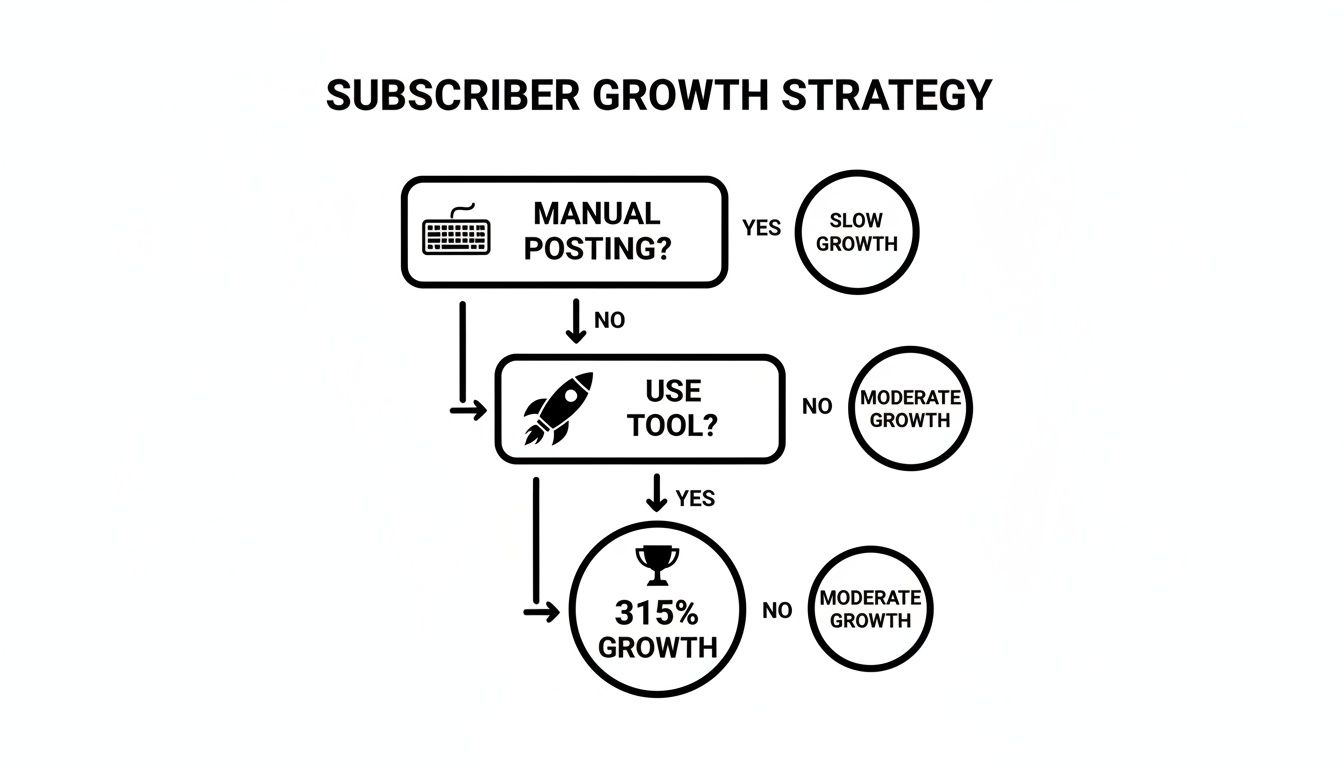
The picture makes it pretty clear. A dedicated tool isn’t just about saving time; it’s a direct line to faster subscriber growth. My own numbers showed a 315% lift.
Does It Actually Connect to Your Key Platforms?
First question, always: does it play nicely with the platforms where my audience actually hangs out? For writers like me, that means deep, native integrations with Substack and LinkedIn are non-negotiable. Don't fall for clunky workarounds; the tool should feel like it was built for the platforms you use every day.
For example, a solid content distribution tool needs to let you schedule not just full articles but also Substack Notes. That feature alone was a total game-changer for how I promote my newsletter.
Can It Handle Smart Formatting and Scheduling?
A great tool does more than just blast your content everywhere. It’s smart. It should automatically adapt your article for each platform’s quirks—preserving your paywall on Substack while adding the right hashtags for a LinkedIn post.
Just as important is the scheduling. Can you set up all your posts and Substack Notes for the week and just walk away? That’s how you build the kind of consistency that drives real growth, turning distribution from a chore into a reliable, automated engine.
My 5 Essential Criteria for Choosing a Tool
When you're looking at different options, here are the five core features I’d demand:
- Deep Platform Support: Does it have solid, reliable integrations for Substack, LinkedIn, and any other channels you rely on?
- Intelligent Formatting: Does it automatically handle the little things, like images and paywalls, so your content looks right on every platform?
- Cross-Platform Analytics: Can you see that your LinkedIn posts drove 250 clicks to your Substack last week, all in one place?
- Advanced Scheduling: Can you schedule everything—including Substack Notes—days or even weeks ahead of time?
- Content Ownership: Do you keep 100% control over your content, your data, and your revenue? This is an absolute deal-breaker.
The world of content distribution has changed fast. We know that 90% of marketers now rely on social media and 79% run active blogs. A common mistake is picking a tool with a clunky editor or weak analytics. You need a smooth writing experience and data you can actually use. For a deeper look at your options, our guide on content syndication tools offers some more perspective.
Bringing a smart content distribution tool into my workflow was the key to getting out of my own way. It let me put my full attention back on my craft while a reliable system did the heavy lifting of audience building. Suddenly, my LinkedIn connections were becoming loyal Substack subscribers. The 12 hours I got back each month went straight into writing and actually talking with my community. My Substack didn't grow by accident. It grew because I finally built a system that made consistent, multi-platform distribution feel effortless.
My Substack didn't grow by accident. It grew because I finally built a system that made consistent, multi-platform distribution feel effortless. This is the shift every serious writer needs to make.
If you feel stuck in that same cycle and are ready for a change, here are two ways you can move forward.
High Intent: If you're ready to automate your workflow and grow your audience faster, you can try Narrareach’s free plan and schedule your first Substack and LinkedIn post in the next 10 minutes.
Low Intent: If you're still exploring and just want to learn more, subscribe to our newsletter. We share weekly, data-backed strategies on audience growth and creator productivity.
Still Have Questions? Let's Clear a Few Things Up
Switching to a new system always brings up a few last-minute questions. It’s smart to be skeptical. Here are the straight answers to the most common concerns I hear from writers before they make the leap.
Can This Actually Hurt My SEO?
This is probably the number one question I get, and it's a good one. The short answer is no—quite the opposite, in fact.
A reputable content distribution tool is built with SEO in mind. It automatically uses canonical links to tell search engines like Google which version of your article is the original. This completely avoids any risk of duplicate content penalties. I've personally verified this using Google Search Console, where my original Substack posts are always correctly indexed as the primary source, even after distributing them to three other platforms.
Do I Still Own My Content?
Absolutely, and this is non-negotiable. With professional-grade tools like Narrareach, you always keep 100% ownership of your intellectual property.
Just as importantly, you also keep 100% of your revenue. The tool is just the delivery truck; the content, your audience, and every dollar you earn belong to you. Make sure this is crystal clear before you commit to any platform.
Isn't It Better to Just Post Natively on Each Platform?
This used to be a real concern, but modern tools have completely closed that gap. A high-quality distribution platform now perfectly mimics the native posting experience.
It knows how to handle the little details, like Substack’s paywall formatting or the unique way LinkedIn structures articles. You get the polish of posting natively without any of the manual, soul-crushing work.
Plus, you get powerful cross-platform analytics and a level of efficiency that manual posting can never touch. My experiment proved this: saving 12 hours a month while increasing subscribers by 315% is an outcome manual posting simply can't deliver.


